Floating Monks in Ampawa

I stood quietly at the edge of the canal, my toes hanging over the edge of the wooden walkway that fronted the row of shops lining the old waterway. The sun was not yet up, but already it was uncomfortably warm. I felt a drop of sweat slide down my spine.
I ignored it. I waited.
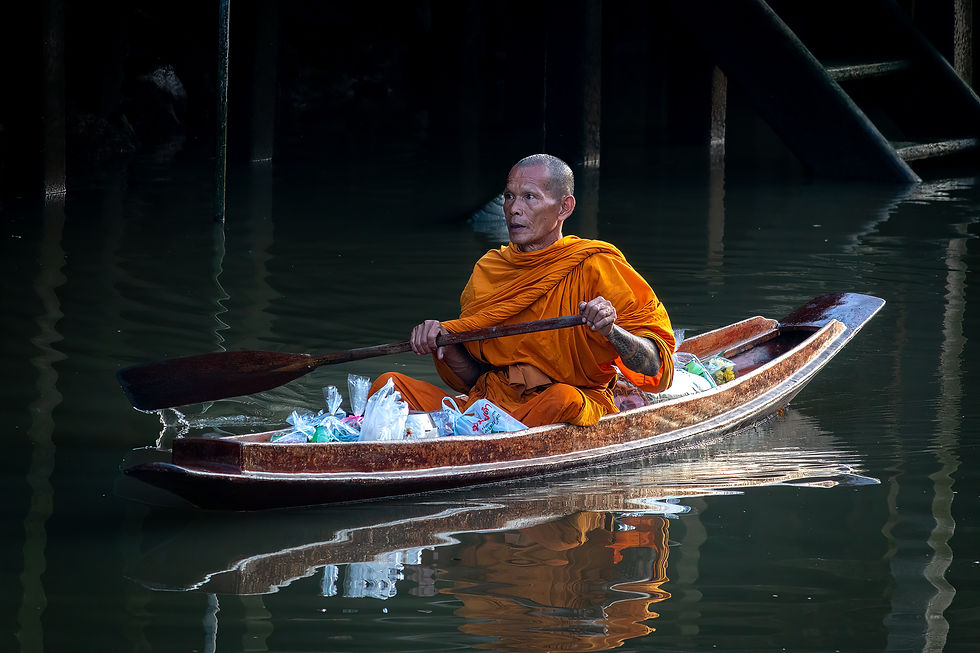
Finally, out of the pre-dawn gloom, I saw what I was waiting for come gliding gently, serenely down the canal. A lone monk paddled a canoe, hugging the far side of the canal, passing right under the shops that lined the opposite side from me. At several of these shops, ladders descended from the walkway to the water’s edge. On a few of these ladders, Thais waited, patiently watching the monk paddle slowly toward them.
As the monk reached a ladder with a waiting person, he stopped, taking hold of the ladder to secure the boat. The waiting person would then hand the monk small bags containing food. The monk placed the bags of food carefully in the canoe in front of him, and then chanted a blessing, the deep, monotonous sound of which bounced around the canal in the otherwise silent morning.
And then the monk paddled on.

All over Thailand (and Southeast Asia), monks make early morning rounds where Buddhists have an opportunity to “make merit” by giving food to begging monks. This is one of my favorite rituals. The emphasis is not on feeding the monks—the emphasis is that those who give food have an opportunity to practice being unselfish. In doing so, they become better people, closer to the ideal of divorcing themselves from worldly desires. The monk is actually giving you a gift by presenting you with the opportunity to be giving.
I had been out early in the morning in Bangkok and seen the monks walking from food stall to food stall, collecting donations.
But now I was in Amphawa, a town known for its floating market. And in Amphawa, many of the monks went out to collect donations not on foot, but in boats.
It was beautiful to watch. And very photogenic.
Which, of course, brings up a traveler’s conundrum. Is it OK to turn religious rituals into tourist attractions by showing up to take pictures? In many cases, my answer to this question (for me) is no. I generally leave my camera in my bag, or at least don’t point it at worshippers in temples. But the general consensus among the monks I have had contact with (as well as Thai people in general) is that photographing merit making is fine so long as you do it discreetly.
And thus I use a long lens so I remain far away, and I tell myself it is OK. But I am still not sure I believe that. I still feel a bit uncomfortable.
But, in Amphawa, I fell to temptation. Because travel.


Mình chơi kiểu giải trí là chính nên không quá áp lực chuyện trúng hay trượt, nhưng vẫn tò mò muốn biết vì sao có dãy số cứ xuất hiện đều, có dãy lại im hơi lặng tiếng mãi. Hồi trước mình chọn theo cảm giác, thấy số nào “hợp mắt” thì chốt, rồi sau đó lại ngồi thắc mắc sao lúc đó mình nghĩ vậy. Từ khi chịu khó theo dõi Thống kê đặc biệt tuần thì mình bắt đầu ghi lại vài cặp hay gặp, rồi đối chiếu thêm nhịp cầu với tần suất xem có khớp không. Có bữa dữ liệu trùng với linh cảm làm mình yên tâm hơn, nhưng cũng có lúc lệch hẳn, nhắc…