Nuts and Bolts: Travel Tips for Visiting Tashkent


Nuts and Bolts posts give you the practical information you need, but without stripping away the humor, mishaps, and little victories that make real travel what it is. These aren’t just guides. They’re how we actually did it—mistakes, triumphs, and all.
This page has some travel tips for visiting Tashkent to aid in planning your own trip. I travel mainly with my wife, and we love to simply wander and eat when we explore a new place. We were in Tashkent in July, 2025. If your trip to Tashkent is significantly longer/shorter/with a different focus, you may have a very different experience.
Welcome to Tashkent, Uzbekistan
Tashkent was our doorway into Uzbekistan—and really, into Central Asia itself. After the long haul it took to get there, it didn’t feel like a city we were meant to conquer so much as one we were meant to stroll into. We were only in town a couple of days, but Tashkent turned out to be exactly what an entry point should be: a place to recalibrate, to get our bearings, to start letting the region feel real rather than theoretical. Explainable. Walkable. Human.
It also didn’t hurt that it was immediately rewarding. Good food. A fascinating layer cake of Soviet architecture. An unexpectedly beautiful subway system that made even simple errands feel like small field trips. And a market that did what good markets always do—pulled us out of our travel fog and dropped us straight into daily life. Tashkent didn’t overwhelm us, but it didn’t fade into the background either. It was interesting without being exhausting, textured without being chaotic. As first chapters go, it was a kind one.

Travel Tips for Visiting Tashkent: Weather
We arrived in Tashkent in July, and there was nothing gentle about the weather for us: it was hot. Not “pleasantly warm,” not “summer vacation hot,” but the kind of heat that quietly reorganizes your entire day whether you consent or not. Uzbekistan in midsummer is not a place where you power through. It is a place you adapt to.
For us, that meant a very consistent daily rhythm—not just in Tashkent, but throughout our time in Uzbekistan. Mornings were for being out in the city. Evenings were for going back out again. The middle of the day belonged almost entirely to air-conditioning. Sometimes that was the hotel. Sometimes a museum. Sometimes a mall. Sometimes any building that looked like it might contain cooled oxygen. This wasn’t laziness; it was logistics. And once we accepted that, Tashkent became far more pleasant. It’s a city that rewards early starts and late wanderings, and forgives you for disappearing for several hours in between.
Outside of peak summer, Tashkent becomes much easier on the body. Spring and fall are widely considered the best times to visit, when days are warm rather than punishing and evenings cool enough to make walking genuinely enjoyable. These are the seasons when the city’s wide boulevards, parks, and markets make the most sense, when you can linger rather than move with purpose from one shaded refuge to the next.
Winter, by contrast, brings cold but generally manageable temperatures. Snow isn’t unusual, and the city takes on a quieter, more muted personality. It’s not the season most people imagine when they picture Uzbekistan, but it can be a comfortable time to explore if you’re more interested in museums, architecture, and food than in long outdoor days.
Tashkent is very livable year-round, but July made one thing very clear to us: in summer, the weather is not a background detail. It is the main character. And if you plan your days around it instead of fighting it, the city gets a lot more generous.
Getting to Tashkent
For most travelers, Tashkent functions exactly the way it did for us: as the front door. It’s Uzbekistan’s main international hub, and for anyone coming from outside Central Asia, flying into Tashkent is by far the most straightforward way to enter the country. This is where the major international routes funnel, where visas and entry formalities feel most routine, and where the infrastructure is built to absorb people who have just come a very long way.
We flew in, and Tashkent did what a good arrival city should do—it worked. The airport delivered us into a functioning capital rather than a logistical puzzle.
From there, the country opens up by rail.
Uzbekistan’s train network is one of the quiet strengths of traveling here, and Tashkent is its center of gravity. High-speed and overnight trains connect the capital to the main cities most travelers are coming to see, and in our case, Tashkent was where we boarded our overnight train to Khiva. There is something deeply satisfying about starting a long overland journey by going to a station, finding your platform, and watching your city slide away into darkness. It felt like the true beginning of the trip.
Practically speaking, this also makes Tashkent an easy place to build a route. Whether you’re heading west toward Khiva, southwest toward Bukhara and Samarkand, or looping back again at the end of a trip, odds are good you’ll pass through Tashkent at least once. Flights knit Uzbekistan to the outside world; trains knit the country together.
Getting Around Tashkent
If there is one practical thing that made our time in Tashkent immediately easier, it was Yandex Go. If you’ve used Uber, the experience is essentially the same. And for arriving in Tashkent, it is by far the simplest way to get from the airport to wherever you are staying.
When you exit the terminal, you’ll walk straight into a line of taxi drivers. This happens in a lot of countries. Tashkent is no exception. Instead of engaging, just keep walking. Cross the parking lot in front of the airport and head toward the small road beyond it (it isn’t a very long walk). There’s a little stand out there selling water and snacks, which makes a useful landmark. That’s where we ordered our Yandex Go car through the app.
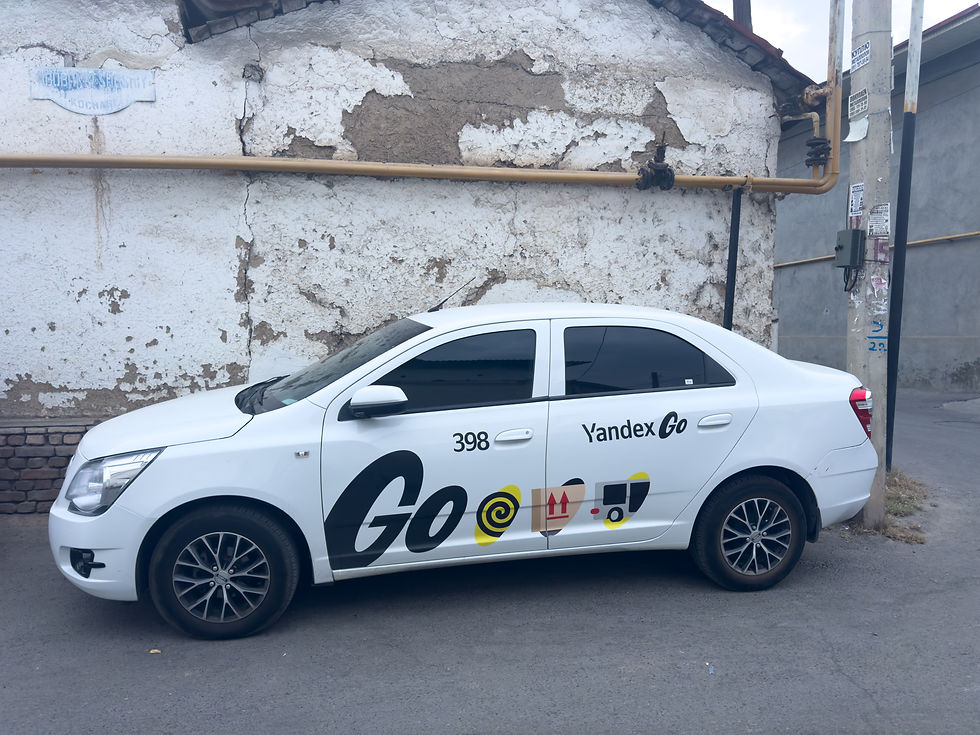
The first price we were quoted by the waiting drivers was $20 US to get to our hotel. Our Yandex ride cost 23,000 som—about $1.86. While we were waiting, a few of those same drivers came back over and told us that Yandex wouldn’t come to the airport, and that they could give us a “special” ride for 100,000 som—about eight dollars. We smiled, said “no thank you”, and a few minutes later our Yandex car pulled up exactly where the app said it would. The ride was easy. The price was the price. And it set the tone for how we moved around the city from that point on.
We used Yandex constantly in Tashkent. It was cheap, smooth, and removed almost all of the small frictions that can make a new city feel more complicated than it actually is. When we were tired, overheated, or just didn’t feel like navigating, we called a car and kept moving.
Do yourself a favor and download Yandex Go to your phone before you even show up in Central Asia.
The other pillar of getting around Tashkent is the metro.

Tashkent’s subway system is inexpensive, easy to use, and—unexpectedly—beautiful. This isn’t a purely functional underground. Stations are decorated, spacious, and varied, with each one feeling like it had been given permission to have a personality. Even when we were taking it simply to get from one place to another, it never quite collapsed into background infrastructure. It always felt like part of the city rather than a tunnel beneath it.
Between Yandex on the surface and the metro below it, Tashkent was one of the least stressful capitals we’ve navigated. Movement was not something we had to solve. It was something that just worked. And with style!
Where to Stay in Tashkent for the Budget Conscious Traveler
We stayed at the Mirzo Boutique Hotel, and we chose it for one reason that matters more than thread count: location. It’s near Chorsu Market, which put us within walking distance of one of the most interesting daily-life spaces in the city and gave us a neighborhood that felt lived in. For a short stay—especially an entry stay, when you’re learning the rhythms of a new country—that mattered more to us than amenities.
The hotel itself was simple and functional, which is exactly what we needed. The one thing that requires honest preparation is the bed. It was, without exaggeration, rock hard. But that turned out not to be a Mirzo issue so much as a regional pattern. Across Central Asia, we repeatedly encountered mattresses that could best be described as “structural.” Knowing this in advance, we had brought inflatable camping mattresses with us, which turned out to be one of the most quietly brilliant decisions of the trip. Without them, our aging backs would have staged a coup somewhere between Tashkent and Almaty.
Mirzo was exactly what we needed it to be: affordable, well-placed, and reliable. It wasn’t a destination in itself. It was a base. And in Tashkent, that’s exactly what you need.
What to eat in Tashkent
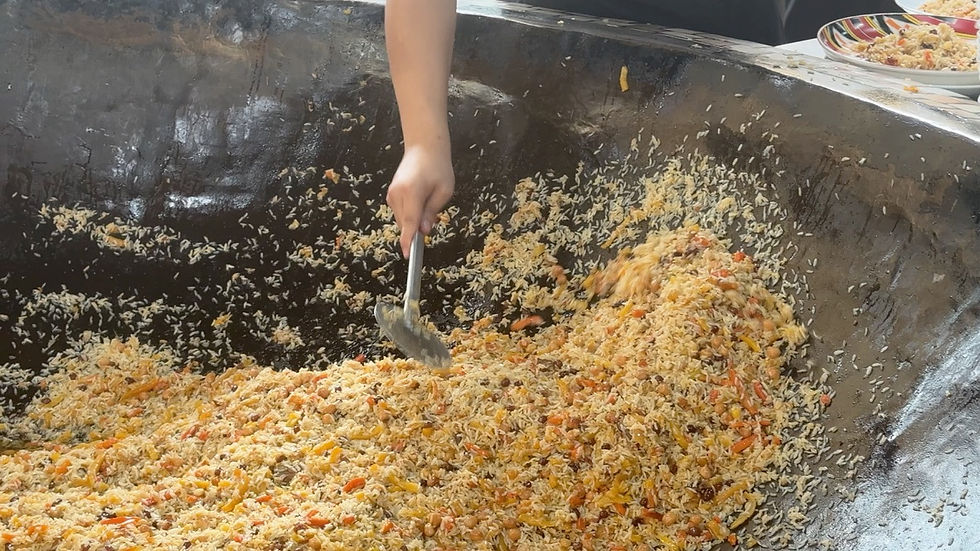
If there is one dish you will meet immediately in Uzbekistan, it is plov. You will see it advertised everywhere, served everywhere, and discussed with the quiet seriousness usually reserved for religion and soccer. Plov is a rice dish cooked with meat, carrots, onions, and oil, but that description does about as much justice as calling a cathedral “a building with windows.” Plov is the backbone of Uzbek cuisine, the default communal meal, and something people care about deeply. Recipes vary by region, by family, and sometimes by day of the week. Some versions are heavy and celebratory. Others are lighter, more aromatic. All of them are meant to be shared.

You can find plov all over the country, but Tashkent is home to one of its most famous expressions. Besh Qozon—often referred to simply as the plov center—is where enormous cauldrons are used to cook it in industrial quantities, the way a city cooks something when it knows exactly what it is about. It’s efficient, theatrical, and very good. Watching plov being assembled at that scale is part of the experience, and guests can walk through the “kitchen” where huge vats of the stuff are being prepared.
Beyond plov, Tashkent turned out to be an excellent introduction to Uzbek food more broadly. National Foods is a strong place to encounter a wide range of traditional dishes in one sitting. It’s the kind of restaurant that works well early in a trip, when you want to try many things and start building a vocabulary for what’s on menus. Afsona is another standout, more polished and more modern, and popular enough that reservations matter. We found it a good reminder that Uzbek cuisine isn’t only preserved—it’s also being interpreted.
And then there is Chorsu Market.
If restaurants teach you what a cuisine looks like when it is organized, markets teach you what it looks like when it is alive. Chorsu is where you see the raw materials: mounds of fruit, nuts, spices, bread, meat. You’ll encounter everything from local horse sausage to piles of dried goods to the round loaves of bread that seem to appear at every table in the country. It’s a place to wander, to taste, and to recalibrate your sense of what food means in daily life.
It is also, very practically, a perfect place to buy snacks—especially if you’re about to get on an overnight train. We picked up food here for our own onward journey, and it felt exactly right: gathering supplies in the city that had just welcomed us, before letting it send us deeper into the country.
In Tashkent, eating wasn’t just something we fit between sights. It was one of the ways the city explained itself.

What To Do in Tashkent
We were only in Tashkent a couple of days, so what follows isn’t a comprehensive account of the city’s sights so much as a record of the places that gave us our first real sense of it. Tashkent is a capital with layers—religious, Soviet, post-Soviet, and something still actively forming—and even a short stay makes it clear that you could build a much longer visit around museums, performances, and neighborhoods alone. This was our introduction, not our conclusion.
One of the major historical and religious centers of the city is the Hazrati Imam Complex. This area brings together mosques, madrasas, and courtyards and is closely tied to Tashkent’s Islamic heritage. Within the complex you can find the Muyi Mubarak Library which has one of the oldest copies of the Quran. Unfortunately, when we were there, much of the complex was closed for construction, which limited how much we could see. Even so, it was clear that this is one of the city’s important cultural anchors and normally a place where you could spend real time moving between buildings, collections, and open spaces. If it’s fully open when you visit, it would likely deserve a prominent place in your plan.

Chorsu Market, by contrast, needs no special conditions. It was one of the places where Tashkent immediately stopped feeling like an abstract capital and started feeling like a living city. The market sits under its massive blue-domed structure and spills outward into surrounding streets, blending formal market halls with outdoor stalls and everyday commerce. It’s where food becomes geography: fruits, nuts, bread, meat, spices, and the ordinary ingredients of daily life. This is not a “stop by for ten minutes” place. It’s somewhere to wander, circle back, get lost, and let the city work on you.

Amir Timur Square offered a very different mood. This is a monumental, open central space built around the figure of Timur, and it functions today as both a symbolic and social center. We especially liked it later in the day, when people began gathering, strolling, sitting, and letting the heat finally loosen its grip. From here, a pedestrian street leads toward Independence Square, making it an easy place to build an evening walk. It felt like one of the city’s shared living rooms.

If Amir Timur Square shows Tashkent’s civic face, Tashkent City Park shows its recreational one. Post-Soviet cities seem to have a particular affection for fountains, and Tashkent embraces this enthusiastically. You’ll see impressive fountain displays throughout the city, but Tashkent City Park concentrates them into something almost celebratory. It’s expansive, landscaped, and unapologetically modern—a place built for strolling, sitting, families, and light rather than history.
Magic City (10:00-22:00) leans even further into that modern, constructed leisure environment. It’s stylized, brightly designed, and very clearly aimed at entertainment. Architecturally and atmospherically, it stands in deliberate contrast to both the historic complexes and the Soviet layers of the city. Even a short visit makes it clear that this is part of Tashkent’s current identity as much as its past is.
One of the more unexpectedly rewarding things to do in Tashkent is simply to ride the metro. The subway system isn’t only transportation; it’s also a gallery of design, with stations that feel individual rather than standardized. Taking time to move between a handful of stops, rather than just riding from point A to point B, quietly becomes its own kind of tour.
See here for our tour through Tashkent’s most impressive subway stations.

Tashkent is also a major museum city. History, applied arts, state museums, and specialized collections are spread throughout the capital, and this is where a longer stay would quickly begin to look different from ours. We dipped into museums as part of our mid-day heat strategy, but it’s obvious that you could build full days around them alone.
And then there is the performing arts. Tashkent supports ballet, opera, symphony, and circus traditions, and the city has the venues to match. Unfortunately, our visit fell in the middle of summer, when much of this calendar seems to go quiet. We weren’t able to attend anything, but the infrastructure is there, and outside of peak heat months, performances appear to be one of the city’s cultural strengths.
Tashkent never tried to impress us in the way that Samarkand, Khiva, or Bukhara later would. It didn’t overwhelm us with monuments or demand long, reverent pauses. Instead, it did something quieter and, in the context of this trip, far more important. It received us.
After the long journey into Central Asia, Tashkent gave us a place to recover, to eat well, to sleep, to learn how to move through Central Asia, to hear a new language rhythm, to begin building the small competencies that make the rest of a trip possible. It let us practice Uzbekistan before Uzbekistan became layered and historical and emotionally saturated.

We figured out the money. We figured out the food. We figured out the subway. We sat in parks. We wandered markets. We disappeared into air-conditioning and came back out again. By the time we boarded our overnight train west, Tashkent had done its work. We weren’t just arriving somewhere new anymore. We were traveling.
And that quiet shift—the moment when a place stops being a destination and starts being a lived space—is one of the reasons we keep going back out into the world, because travel isn’t only about what we see. It’s about what changes in us once a place has had time to do its small, invisible work.
As first chapters go, Tashkent is generous.


Comments