Turtuk, India: A Remote Karakoram Village Too Beautiful to Be Real”

Updated: Oct 24, 2025

This is part of a series that describes the road trips we took from Leh. This post covers our visit to Turtuk, India. The other posts in the series are:
Day trip to the south of Leh (Takthok, Chemrey, Hemis, Thiksey, and the Shey Palace)
Overnight trip to Lamayuru (Indus River, Bagso, Likir, Alchi, and Lamayuru)
You can also find a post with a little bit of background on the Ladakh region here.
The prices to hire car and driver for these trips and many others are set by the Leh Taxi Union. You can find current prices at their website.
At the end of a very, very long drive from Pangong Lake, our driver dropped us off. He unloaded our bags from the trunk, gave us a friendly wave, and off he went.
It all happened so fast. Before we knew it, we were standing on the side of a dusty street, our bags sitting in a pile at our feet. Our driver was gone. We were all alone.
We were in Turtuk.
Wait . . .
I looked around. There was nothing. Nothing. No town. No shops. No hotels. Nothing.
Across the street there were fields of . . . something growing. Barley? There were a few scattered people working in those fields, but no one else was around.
Seriously . . . there was nothing.
Where were we?
Shangri La is Passé: Go to Turtuk, India
Five years earlier, Turtuk was strictly off limits for travelers. It was too close to the “Line-of-Control” the de facto border between India and Pakistan. But Turtuk was open now, assuming you were willing and able to pick up the necessary permit (the Inner Line Permit is actually easy to get. Your driver, or their agency, will do most of the work).

Rumors portrayed Turtuk as a place that feels whispered rather than spoken—a sliver of green set against the endless brown expanse of the barren Karakoram peaks. The place was merely miles Pakistan, nestled into a quiet fold of the Shyok River valley, as remote as it is breathtaking.
Travelers with the tenacity to make it to Turtuk described stone homes balanced on narrow ledges. Water channels glinting through groves of apricot trees. The smell of woodsmoke, river mist, and time.
Turtuk didn’t just seem remote—it felt downright improbable, like a village still sleeping gently in a myth, not quite fully present in our world.
Turtuk was the kind of place travelers spend their lives searching for. And we had an opportunity to go.

So we were confused when we found ourselves standing not in an idyllic mountain town, but on a road, with nothing but dust for company. The mountain was at our back. The river valley spread out in front of us. The road stretched as far as we could see in both directions. Empty.
Did the driver let us off at the wrong spot?
Was this a Brigadoon situation?
Where were we?
The region Turtuk sits in had once been part of Pakistani Baltistan, but in 1971, a war broke out and borders shifted. Turtuk remained where it had always been, but the conflicting countries moved around it. Turtuk became a part of India.
But it feels different than the rest of Ladakh. You don’t see gompas. Or monks. Or stupas. Signs are in Balti, or Urdu.
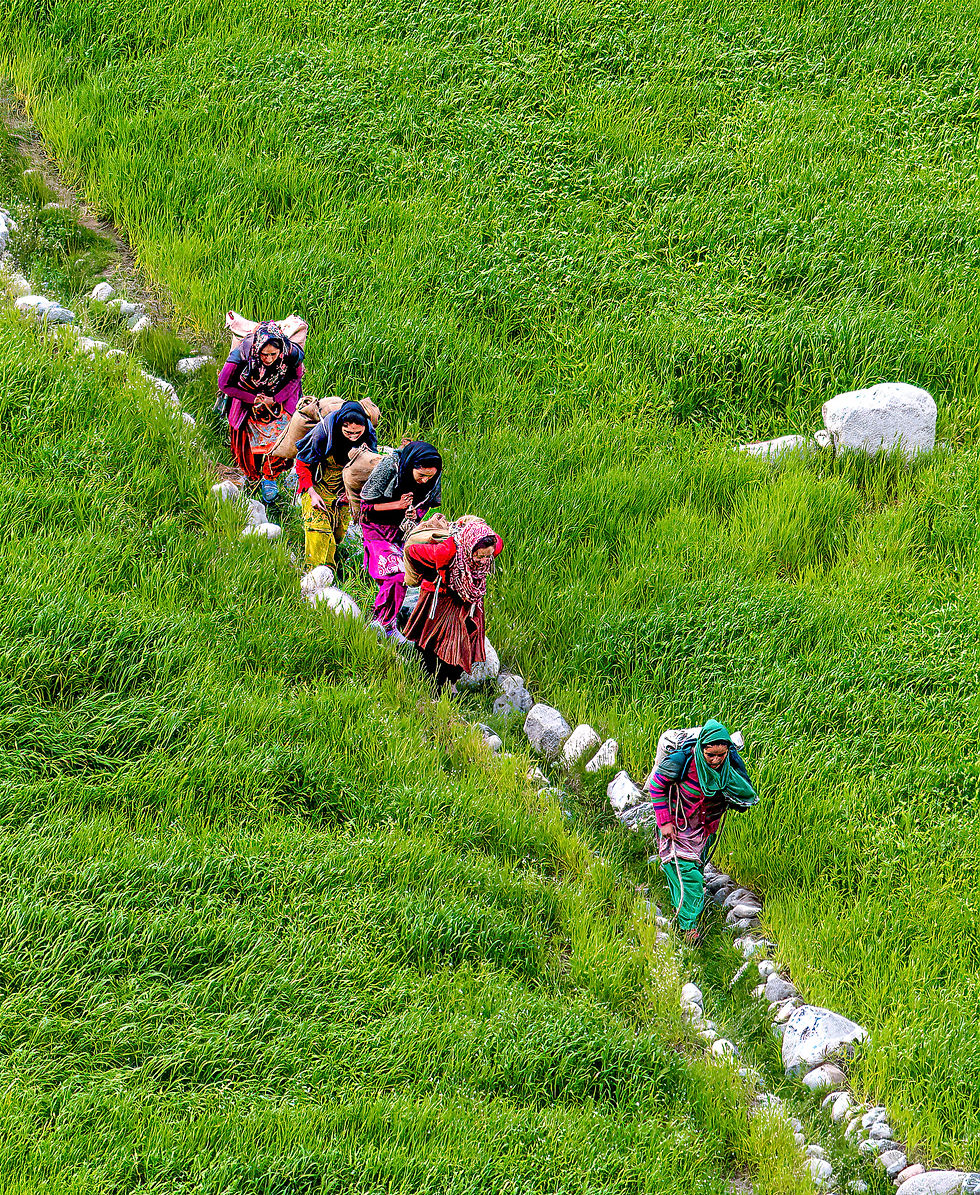
In fact, Turtuk is one of only a handful of places in India where you can hear Balti spoken today. So, when we saw a woman, laden with bundles of barley on her back walking towards us from the riverside fields, I started cursing myself for not downloading Balti into Google Translate.
“Is Balti in Google Translate?” my wife asked.
“I don’t know. Let me check . . .” But I couldn't check. Unsurprisingly, there was no cellular data, standing there on the empty street in the Karakoram mountains, far away from anything.
I watched the woman walk along the road, slowly towards us, and I psyched myself up for an epic game of charades. I figured that in the worst-case scenario, we were in the totally wrong spot, but the Balti people are famous for their hospitality. It was unlikely we would freeze to death come nightfall. Someone would take us in.
But still . . . we were road-weary and wanted to find Turtuk and get settled.
So I got ready to try and communicate with the woman.
But I didn’t get the chance. A bit before she reached us, she turned off the road, and onto a well-camouflaged, but also well-worn path. A path that cut switchbacks up the mountain. Up the mountain towards . . . something. Turtuk?
Decision time.
The decision was not whether to explore the path. The path was our only option, so we needed to ascend and see if it led us to Turtuk. No, the decision was whether to carry our bags with us or not. If the path wasn’t the route to the village, and we carried our bags up, we would have lugged all that extra weight in the oxygen depleted air.
On the other hand, if we didn’t carry bags up and the path did lead to the village, we would just have to descend back down and climb again, this time weighed down with luggage.
We decided to have faith. We carried our bags.
It turned out to be the right decision.
Arrival in Turtuk (Finally!)
It is hard to describe what it is like to climb up that path. We climbed it many times over the next four day while we were in Turtuk. And every time, it was like a slow reveal of something that seems too good to be real.
The whole Shyok river valley is shades of gray and brown. Heck, the Shyok River itself is shades of gray and brown. So when you finally climb high enough that the hanging plateau that Turtuk sits on reveals itself, it is like the village is trying to make you remember that there are more colors in the world. And specifically, that this is a green planet. And it drives this point home well.

The surface of the plateau was covered in stepped fields of young barley. Apricot trees dotted the landscape. Water ran in channels, helping keep the barley fields green and healthy. And, at the back of the plateau, stone houses were gathered into a small village.
While we stood there, grateful we had found Turtuk, and gob smacked at just how perfect it was, a group of school-aged kids came running straight for us. They gathered around us, all smiles and incomprehensible chatter.

One took my hand, looked me in the eye, and said . . . something. I have no idea. I looked at him and asked “guesthouse?” His eyes lit up and he and his friends tore off down the raised paths through the barley fields, beckoning for us to follow.
Follow we did.
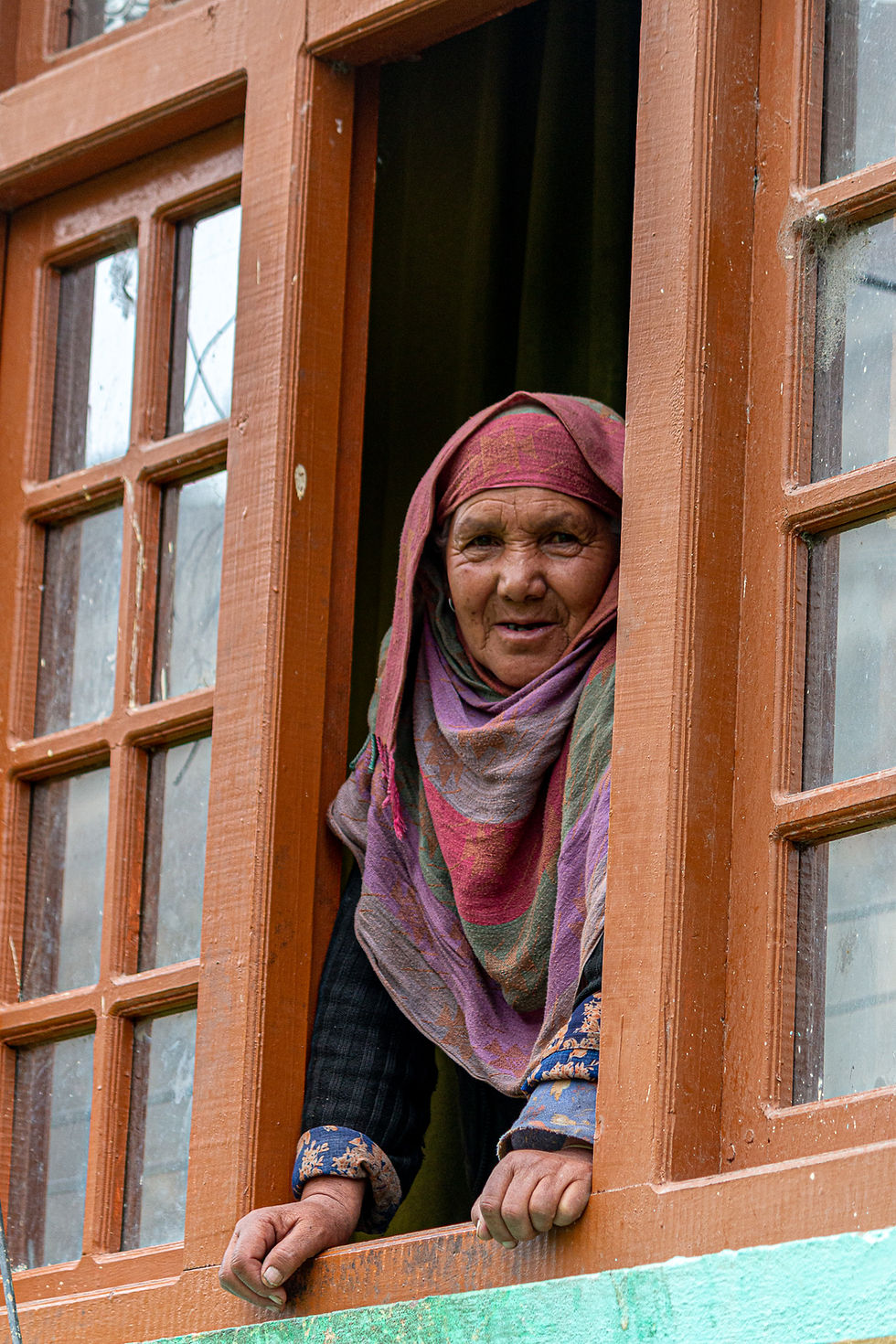
They led us to a guesthouse where they showed us a very nice room, all windows and blankets (the two most crucial things in a guesthouse in Turtuk). The room came with breakfast and dinner, great views, and a “travel grandma.” We have had many travel grandmas over the years, and we always love them. Our Turtuk grandma took special interest in our daughters, making sure they were warm, and fed, and happy.
We spent three more full days in Turtuk. I got up early and hiked in the mountains above the town. I sat in the barley fields under an apricot tree and read. We chatted with the kids in their school uniforms.

We ate so many dried apricots we practically started to sweat sticky-sweet paste.
When it was time to head back, we just sauntered into the main restaurant/hang out spot at one end of town. Drivers congregated there, and it was easy to engage a driver to take us back to Leh the following day.

Turtuk was glorious. It was the kind of place you hope one minute that everyone gets to go see, and then the next you hope no one else ever finds it so it doesn’t get overrun by travelers. For the time being, Turtuk is likely safe from the loved-to-death curse because it is still a long, uncomfortable, uncertain journey to get there.
But I will tell you something: Turtuk is worth it. If you want a place to just let everything go, feel the layers of soot and static that accumulate on us in our everyday modern lives, go to Turtuk. Just sit in the fields, under a tree. Look out from your oasis to the barren slopes and river valley that surround you.
It is cleansing just to be there.
And however you express gratitude, give thanks for the amazing places you get to sit —because travel.


Comments