A Self-Guided Tour of the Tashkent Metro


At some point in Tashkent, the subway stops being just a way to get from one place to another and quietly becomes something else entirely. A gallery. A history lesson. A civic statement buried underground. We had heard—correctly—that the metro stations here were beautiful, but like most things in travel, the scale of that beauty doesn’t really register until you’re standing on a platform, waiting for a train, realizing that someone once decided this should be more than concrete and fluorescent lights.
The Tashkent Metro opened in 1977, the first subway system in Central Asia, and it was built very much in the Soviet tradition of monumental public infrastructure. These stations were designed not just to move people efficiently, but to project meaning: culture, labor, science, literature, national pride. After independence, that visual language didn’t disappear—it evolved. Newer stations lean modern and minimalist, while older ones remain richly decorative, each with its own identity.
For decades, photography in the metro was prohibited, which only added to its mystique. That ban has been lifted, and photography is now allowed, though it’s still not something everyone expects or encourages. The basic rules are simple: no tripods, no flash, be respectful, and don’t turn a functioning transit system into a personal studio. If you move deliberately, stay out of the way, and keep things low-key, it’s an incredibly rewarding place to photograph.
This route is based on the tour of the Tashkent metro system we did. We spent a couple of hours in the underground during the heat of midday, and it was one of our favorite things we did in Tashkent. This tour is not exhaustive, but it hits a wide range of styles and atmospheres and makes for a very manageable half-day experience.
Logistics for Your Tour of the Tashkent Metro
Using the Tashkent Metro is refreshingly easy. You buy a token at the station entrance, pass through the turnstiles, and you’re in. There’s no distance-based pricing and no complicated fare structure to decode. Trains run frequently, stations are clearly marked, and signage is straightforward enough that even first-time riders won’t feel lost.
Security screening is present at station entrances, but it’s quick and routine. Once inside, the system feels calm and orderly. And because stations themselves are part of the attraction, this is one of those rare metro systems where moving slowly actually improves the experience.
At most stops, there will be signs that hang over the tracks on both sides of the station. They will indicate the line you are on, the next stop on that line in either direction, and if there is a tranfer to another line, which way you should walk to find that transfer.
At some point in Tashkent, the subway stops being just a way to get from one place to another and quietly becomes something else entirely. A gallery. A history lesson. A civic statement buried underground. We had heard—correctly—that the metro stations here were beautiful, but like most things in travel, the scale of that beauty doesn’t really register until you’re standing on a platform, waiting for a train, realizing that someone once decided this should be more than concrete and fluorescent lights.
The Tashkent Metro opened in 1977, the first subway system in Central Asia, and it was built very much in the Soviet tradition of monumental public infrastructure. These stations were designed not just to move people efficiently, but to project meaning: culture, labor, science, literature, national pride. After independence, that visual language didn’t disappear—it evolved. Newer stations lean modern and minimalist, while older ones remain richly decorative, each with its own identity.
For decades, photography in the metro was prohibited, which only added to its mystique. That ban has been lifted, and photography is now allowed, though it’s still not something everyone expects or encourages. The basic rules are simple: no tripods, no flash, be respectful, and don’t turn a functioning transit system into a personal studio. If you move deliberately, stay out of the way, and keep things low-key, it’s an incredibly rewarding place to photograph.
This route is based on the tour of the subway system we did. We spent a couple of hours in the underground during the heat of midday, and it was one of our favorite things we did in Tashkent. This tour is not exhaustive, but it hits a wide range of styles and atmospheres and makes for a very manageable half-day experience.
Logistics before you go underground
Using the Tashkent Metro is refreshingly easy. You buy a token at the station entrance, pass through the turnstiles, and you’re in. There’s no distance-based pricing and no complicated fare structure to decode. Trains run frequently, stations are clearly marked, and signage is straightforward enough that even first-time riders shouldn't feel lost.
Security screening is present at station entrances, but it’s quick and routine. Once inside, the system feels calm and orderly. And because stations themselves are part of the attraction, this is one of those rare metro systems where moving slowly actually improves the experience.
Starting point: Yunus Rajabi

We started our tour after visiting the State Museum of the Timurids, which puts you conveniently close to Yunus Rajabi station. This station is one of the more modern entries in the system, named after a prominent Uzbek musician and composer, and it serves as a quiet, understated introduction to the metro.
The design is clean and elegant, relying on white marble, restrained lighting, and symmetry rather than ornamentation. It sets an understated tone. After walking through museums and city streets above ground, descending into Yunus Rajabi felt like a gentle transition rather than a plunge.
Photographically, this station rewards simplicity. The polished floor tiles work beautifully for symmetry and reflection shots, and the lighting is bright enough that handheld wide-angle photos come easily. Framing the platform or entrances through the central columns gives a strong sense of structure without needing to rush.
From here, get on the green line toward Abdullah Kadiri and ride three stops.
Bodomzor
Bodomzor is part of the Yunusobod line expansion and represents Tashkent’s newer metro aesthetic. Sleek, contemporary, and functional, it trades decorative storytelling for clean lines and metallic finishes. It’s a sharp contrast to what many people imagine when they think “Soviet metro,” and that contrast is part of the appeal.
This is a station about geometry rather than ornament. Strong perspectives, repeating elements, and architectural restraint define the space. It feels modern, efficient, and intentional.
For photography, this is where minimalism shines. Focus on lines and textures. Use staircases, platform edges, and ceiling elements to create depth. It’s less about individual details and more about composition.
After spending time here, ride back the way you came toward Minor, returning three stops to Yunus Rajabi. From there, connect to the red line toward Mustakilik.

Mustakilik Maydoni
Formerly Lenin Square, Mustakilik Maydoni sits near Independence Square and marks a shift in tone. This is a grand station, with marble pillars, ornate lighting, and decorative motifs that reflect national identity in its post-Soviet form.
The space feels ceremonial. Long corridors stretch away under chandeliers, and everything about the design encourages you to look up and slow down. It’s a station that carries both historical weight and contemporary symbolism.
This is a great place for centered, symmetrical shots. Frame the columns in long perspectives, capture the chandeliers overhead, and be prepared for lower light levels. A slightly higher ISO helps here, but steady hands go a long way.
Stay on the red line in the same direction.

Pakhtakor
Pakhtakor translates to “cotton grower,” and the station reflects Uzbekistan’s long and complicated relationship with cotton production. Bas-relief panels depict rural life and harvest imagery, and the station is bathed in a warm, amber glow that feels distinctly nostalgic.
There’s a softness here, both in color and mood, that makes it one of the most atmospheric stations on the route. It feels lived-in, familiar, and quietly proud.
Photographically, this is a place to work the curves. Low angles exaggerate the ceiling arches, while closer shots let you isolate artwork and textures. The lighting gives everything a warm cast that feels almost cinematic.
From Pakhtakor, walk to the connecting blue line station.

Alisher Navoi
Alisher Navoi is one of the most iconic stations in the Tashkent Metro, named after the 15th-century poet and philosopher. The design draws heavily from Timurid and Islamic architectural traditions, with vaulted blue ceilings, patterned tilework, and ornate lighting that gives the station an almost sacred atmosphere.
This is where the metro stops feeling like infrastructure and starts feeling like a cultural statement. It’s quiet, immersive, and visually rich without being overwhelming.
This station rewards patience. Stand centered on the platform and shoot straight down its length. Frame chandeliers against the domed ceilings. The light is dimmer here, so brace yourself against columns if needed and let the symmetry do the work.
From here, ride the blue line toward Uzbekistan Station, going two stops.

Kosmonavtlar
Kosmonavtlar is dedicated to the Soviet space program and is easily one of the most visually striking stations in the entire system. Blue murals of Yuri Gagarin and other cosmonauts glow against dark backgrounds, punctuated by star-like patterns that make the whole station feel immersive and otherworldly.
Stepping onto the platform here feels like entering a carefully designed narrative. Science, ambition, and ideology are all on display, rendered in color and light.
Photography here is about contrast. The blues are intense, and wide shots that capture the full arc of the murals work especially well. Look for compositions that balance portraits with the cosmic elements surrounding them.
Next, head back on the blue line toward Uzbekistan Station, traveling three stops.

Gafur Ghulom
Named after a revered Uzbek poet, Gafur Ghulom is quieter and more restrained. Ceramic tiles form geometric patterns, and decorative elements are modest rather than monumental. Compared to Kosmonavtlar, it feels contemplative.
Detail work shines here. Focus on textures, repeating shapes, and architectural rhythm. It’s a good place to slow down and notice the smaller design choices that might be missed elsewhere.
From here, ride toward Chorsu, going two stops.

Tinchlik
Tinchlik means “peace,” and the station lives up to its name. Clean lines, soft lighting, and careful symmetry give it a calm, orderly feel. It’s not heavily decorated, but its spaciousness and balance create a sense of ease.
Mid-platform shots work well here, especially those that emphasize depth and vanishing points. This is a station that photographs best when you let it breathe.
Continue riding toward Beruniy.
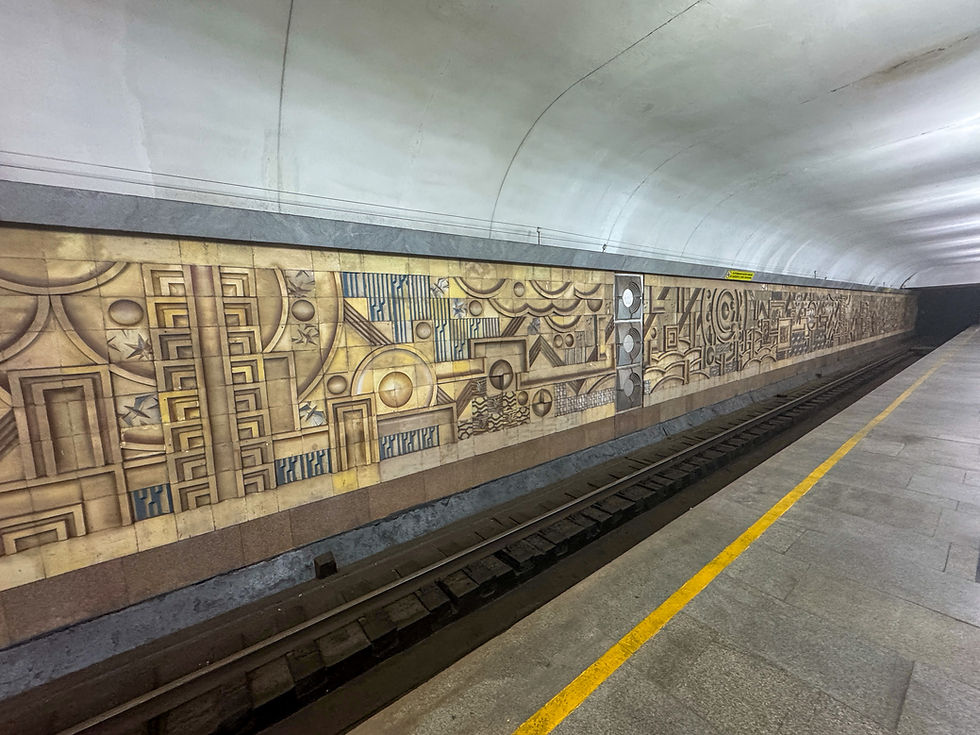
Beruniy
Beruniy, named after the medieval scholar Al-Biruni, is the terminus of the blue line. Brightly lit and boldly structured, it feels like an arrival point rather than a pause. While it lacks the ornamentation of some other stations, it has presence.
The wide entryways, clean signage, and strong geometry give it a modern, commanding feel. Angled shots down the tracks capture a sense of scale and finality—an ending that feels intentional.

Ending the tour (and getting where you’re going next)
From Beruniy, the formal tour ends, but the system keeps working for you. Ride back down the blue line to Pakhtakor if you’re heading to Tashkent City Park. To return to Amir Timur Square, take the blue line back to Alisher Navoi, walk to the red line station at Pakhtakor, and ride toward Mustakilik Maydoni, getting off at the square.
For us, getting back to our hotel meant riding the blue line to Gafur Ghulom.
By the time we surfaced again, the metro had quietly reshaped how we understood the city. Tashkent above ground is wide, hot, and modernizing. Below ground, it is thoughtful, expressive, and surprisingly intimate. Moving through these stations wasn’t just transit—it was one of the most memorable ways the city explained itself, because travel has a habit of revealing its best stories in places you weren’t originally planning to linger.
Starting point: Yunus Rajabi
We started our tour after visiting the State Museum of the Timurids, which puts you conveniently close to Yunus Rajabi station. This station is one of the more modern entries in the system, named after a prominent Uzbek musician and composer, and it serves as a quiet, understated introduction to the metro.
The design is clean and elegant, relying on white marble, restrained lighting, and symmetry rather than ornamentation. It sets an understated tone. After walking through museums and city streets above ground, descending into Yunus Rajabi felt like a gentle transition rather than a plunge.
Photographically, this station rewards simplicity. The polished floor tiles work beautifully for symmetry and reflection shots, and the lighting is bright enough that handheld wide-angle photos come easily. Framing the platform or entrances through the central columns gives a strong sense of structure without needing to rush.
From here, get on the green line toward Abdullah Kadiri and ride three stops.
Bodomzor
Bodomzor is part of the Yunusobod line expansion and represents Tashkent’s newer metro aesthetic. Sleek, contemporary, and functional, it trades decorative storytelling for clean lines and metallic finishes. It’s a sharp contrast to what many people imagine when they think “Soviet metro,” and that contrast is part of the appeal.
This is a station about geometry rather than ornament. Strong perspectives, repeating elements, and architectural restraint define the space. It feels modern, efficient, and intentional.
For photography, this is where minimalism shines. Focus on lines and textures. Use staircases, platform edges, and ceiling elements to create depth. It’s less about individual details and more about composition.
After spending time here, ride back the way you came toward Minor, returning three stops to Yunus Rajabi. From there, connect to the red line toward Mustakilik.
Mustakilik Maydoni
Formerly Lenin Square, Mustakilik Maydoni sits near Independence Square and marks a shift in tone. This is a grand station, with marble pillars, ornate lighting, and decorative motifs that reflect national identity in its post-Soviet form.
The space feels ceremonial. Long corridors stretch away under chandeliers, and everything about the design encourages you to look up and slow down. It’s a station that carries both historical weight and contemporary symbolism.
This is a great place for centered, symmetrical shots. Frame the columns in long perspectives, capture the chandeliers overhead, and be prepared for lower light levels. A slightly higher ISO helps here, but steady hands go a long way.
Stay on the red line in the same direction.
Pakhtakor
Pakhtakor translates to “cotton grower,” and the station reflects Uzbekistan’s long and complicated relationship with cotton production. Bas-relief panels depict rural life and harvest imagery, and the station is bathed in a warm, amber glow that feels distinctly nostalgic.
There’s a softness here, both in color and mood, that makes it one of the most atmospheric stations on the route. It feels lived-in, familiar, and quietly proud.
Photographically, this is a place to work the curves. Low angles exaggerate the ceiling arches, while closer shots let you isolate artwork and textures. The lighting gives everything a warm cast that feels almost cinematic.
From Pakhtakor, walk to the connecting blue line station.
Alisher Navoi
Alisher Navoi is one of the most iconic stations in the Tashkent Metro, named after the 15th-century poet and philosopher. The design draws heavily from Timurid and Islamic architectural traditions, with vaulted blue ceilings, patterned tilework, and ornate lighting that gives the station an almost sacred atmosphere.
This is where the metro stops feeling like infrastructure and starts feeling like a cultural statement. It’s quiet, immersive, and visually rich without being overwhelming.
This station rewards patience. Stand centered on the platform and shoot straight down its length. Frame chandeliers against the domed ceilings. The light is dimmer here, so brace yourself against columns if needed and let the symmetry do the work.
From here, ride the blue line toward Uzbekistan Station, going two stops.
Kosmonavtlar
Kosmonavtlar is dedicated to the Soviet space program and is easily one of the most visually striking stations in the entire system. Blue murals of Yuri Gagarin and other cosmonauts glow against dark backgrounds, punctuated by star-like patterns that make the whole station feel immersive and otherworldly.
Stepping onto the platform here feels like entering a carefully designed narrative. Science, ambition, and ideology are all on display, rendered in color and light.
Photography here is about contrast. The blues are intense, and wide shots that capture the full arc of the murals work especially well. Look for compositions that balance portraits with the cosmic elements surrounding them.
Next, head back on the blue line toward Uzbekistan Station, traveling three stops.
Gafur Ghulom
Named after a revered Uzbek poet, Gafur Ghulom is quieter and more restrained. Ceramic tiles form geometric patterns, and decorative elements are modest rather than monumental. Compared to Kosmonavtlar, it feels contemplative.
Detail work shines here. Focus on textures, repeating shapes, and architectural rhythm. It’s a good place to slow down and notice the smaller design choices that might be missed elsewhere.
From here, ride toward Chorsu, going two stops.
Tinchlik
Tinchlik means “peace,” and the station lives up to its name. Clean lines, soft lighting, and careful symmetry give it a calm, orderly feel. It’s not heavily decorated, but its spaciousness and balance create a sense of ease.
Mid-platform shots work well here, especially those that emphasize depth and vanishing points. This is a station that photographs best when you let it breathe.
Continue riding toward Beruniy.
Beruniy
Beruniy, named after the medieval scholar Al-Biruni, is the terminus of the blue line. Brightly lit and boldly structured, it feels like an arrival point rather than a pause. While it lacks the ornamentation of some other stations, it has presence.
The wide entryways, clean signage, and strong geometry give it a modern, commanding feel. Angled shots down the tracks capture a sense of scale and finality—an ending that feels intentional.
Ending the tour (and getting where you’re going next)
From Beruniy, the formal tour ends, but the system keeps working for you. Ride back down the blue line to Pakhtakor if you’re heading to Tashkent City Park. To return to Amir Timur Square, take the blue line back to Alisher Navoi, walk to the red line station at Pakhtakor, and ride toward Mustakilik Maydoni, getting off at the square.
For us, getting back to our hotel meant riding the blue line to Gafur Ghulom.
By the time we surfaced again, the metro had quietly reshaped how we understood the city. Tashkent above ground is wide, hot, and modernizing. Below ground, it is thoughtful, expressive, and surprisingly intimate. Moving through these stations wasn’t just transit—it was one of the most memorable ways the city explained itself, because travel has a habit of revealing its best stories in places you weren’t originally planning to linger.

Comments