Shah-i-Zinda in Samarkand: Walking the City of the Dead


Shah-i-Zinda is a necropolis—a city of the dead—built along a narrow, rising street on the edge of Samarkand. It is a place of tombs and mausoleums, of saints and nobles, of centuries layered one after another in glazed brick and tile. On paper, that description sounds solemn, maybe even austere. In reality, Shah-i-Zinda is one of the most visually arresting and emotionally affecting places I have ever walked.
You enter and begin moving slowly uphill, hemmed in by mausoleums on both sides, their façades wrapped in blue tile so rich it feels almost liquid. At first, the light is gentle—soft enough to reveal texture without glare. As you walk, the sun lowers, and the blues deepen. Shadows stretch across the narrow passage. Details emerge and then slip away. By the time dusk arrives, the space feels suspended somewhere between worlds: not quite day, not quite night. The tombs glow faintly. The air cools. Voices soften. Walking Shah-i-Zinda at this hour doesn’t feel like sightseeing so much as passage—through history, through light, through a place where beauty and mortality coexist without contradiction.

A Brief History of Shah-i-Zinda in Samarkand
Shah-i-Zinda’s history begins with a legend, which feels appropriate for a place that never quite settles into ordinary reality. The name means “The Living King,” and it refers to Qusam ibn Abbas, a cousin of the Prophet Muhammad who is believed to have brought Islam to this region in the 7th century. According to tradition, he was martyred here—but instead of dying, he descended into a well and continues to live, hidden from the world. Whether you take that literally or symbolically, the story gave the site immense spiritual weight.

Over the centuries, Shah-i-Zinda grew organically rather than according to a single master plan. What began as a shrine became a necropolis for the elite, especially during the Timurid period in the 14th and 15th centuries. Members of Timur’s family, military leaders, nobles, and religious figures were buried along this narrow path, each mausoleum added as an act of devotion, status, and remembrance.
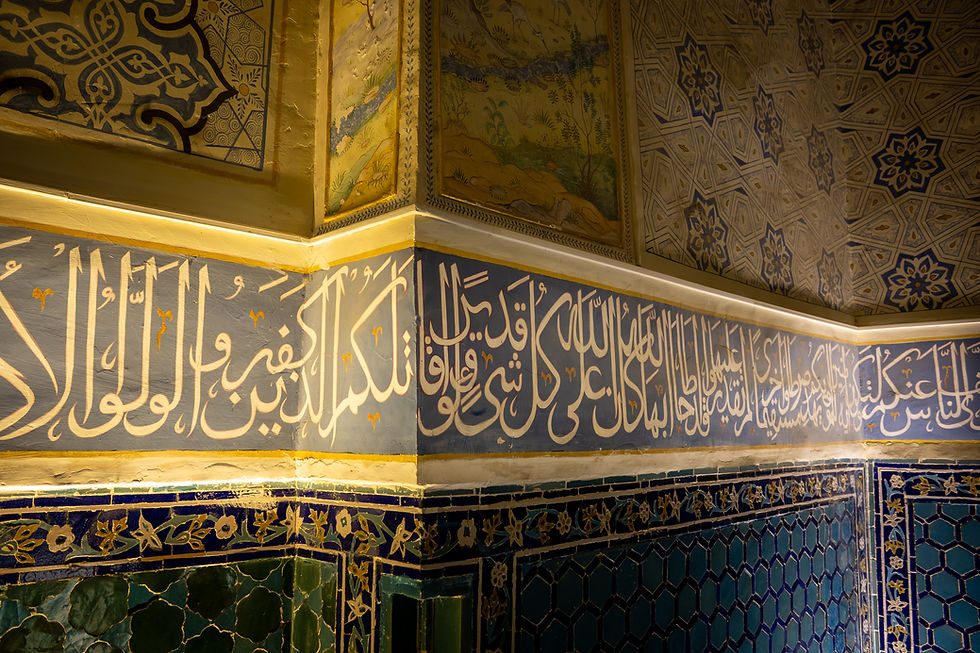
This piecemeal growth is part of what makes Shah-i-Zinda so compelling. Unlike the Registan, which asserts symmetry and control, Shah-i-Zinda feels intimate and layered. Each tomb reflects the artistic style and priorities of its moment—changes in tilework, calligraphy, proportions, and ornamentation quietly marking the passage of time. Walk the street slowly and you’re not just moving uphill; you’re moving forward through centuries of belief, power, and grief rendered in blue and gold.

Despite destruction from earthquakes and invasions, the complex endured, restored again and again because it mattered deeply to the people of Samarkand. Shah-i-Zinda was never abandoned. It was protected, repaired, and revisited, generation after generation, as a place where the living could remain in conversation with the dead.
That continuity is still palpable. Shah-i-Zinda doesn’t feel like a relic sealed behind glass. It feels like a place that remembers what it was built for—and quietly continues to serve that purpose.

Architecture Meant to Be Walked
Shah-i-Zinda isn’t architecture you admire from a distance. It’s architecture that unfolds as you move.

The narrow processional street is the spine of the complex. The mausoleums press in from both sides, close enough that you can reach out and touch the tile.
There’s no sweeping panorama here, no single vantage point that explains the whole. Instead, the space reveals itself in fragments—one façade, one doorway, one burst of blue at a time. You don’t wander Shah-i-Zinda so much as you are guided through it, your pace slowed, your attention narrowed.
Each mausoleum is its own statement. Built over generations, they differ subtly in proportion, ornamentation, and style. Some are restrained, others lavish. Together they form a layered conversation across centuries—expressions of devotion, power, grief, and memory rendered in brick and glaze. Unlike the unified grandeur of the Registan, Shah-i-Zinda feels personal. Human-scaled. Intimate.
The tilework here rewards closeness. From just a few steps away, you start to notice variations in color and glaze, slight imperfections, the evidence of hands at work. Blues shift from turquoise to deep cobalt, interrupted by white calligraphy and vegetal patterns that seem to grow organically across the walls. This isn’t tile meant to dominate a skyline. It’s tile meant to be seen at arm’s length.

Look up and you’ll see domes stacking above the passageway, creating a gentle vertical rhythm that pulls your eye skyward even as the walls keep you enclosed. Doorways are crowned with delicate muqarnas—honeycomb-like forms that soften transitions and dissolve solid mass into geometry. These aren’t grand gestures meant to impress a crowd. They mark thresholds, reminding you that each step forward is also a passage between worlds.
Light completes the design. The narrowness of the street means sunlight arrives obliquely, sliding across façades rather than flooding them. As the day fades, shadows deepen, blues darken, and the tile begins to glow rather than shine. By dusk, the architecture feels almost suspended—no longer fully of the day, not yet of the night.
Shah-i-Zinda works because it was built to be experienced slowly. Its architecture doesn’t ask you to stand back in awe. It asks you to walk, to look closely, and to feel your way through a place where beauty and mortality share the same narrow path.

Shah-i-Zinda stays with you in a quieter way than the great open squares of Samarkand. It doesn’t overwhelm through scale or symmetry. Instead, it lingers. Long after you’ve left, you remember the way the blue tile caught the last light of the day, how the passage narrowed your focus, how the city of the dead felt unexpectedly alive.
Walking that street, you’re reminded that travel isn’t always about standing in front of something monumental and feeling small. Sometimes it’s about moving slowly through a place where beauty, memory, and loss are woven together so carefully that they feel inseparable. Shah-i-Zinda doesn’t ask you to rush. It asks you to pay attention.
That’s why moments like this matter. Not because they can be planned or replicated, but because travel puts you inside spaces where time softens, where history feels close enough to touch, and where connection happens quietly, without explanation—because travel has a way of revealing meaning in the smallest, most human details.
Nuts and Bolts: How to Visit the Shah-i-Zinda

Location
Shah-i-Zinda sits on the northeastern edge of Samarkand, a bit removed from the Registan area but still easy to reach. If you’re staying near the city center, it’s a short and inexpensive ride using the Yandex Go rideshare app. You can also walk if you’re feeling ambitious, but in summer heat, a car is the sensible choice.
Hours
The complex generally opens early in the morning and closes in the evening, though posted hours can vary slightly by season. When we visited, it was open from early morning until after sunset. If timing matters to you (and it probably should), aim to arrive late in the afternoon, about an hour before sunset. This gives you time to walk the complex in soft light and stay as the atmosphere shifts toward dusk.

Entry Fee
There is a single entrance fee to access Shah-i-Zinda. In summer 2025, the cost was 40,000 som (about $3 USD). Tickets are checked at the main gate, and re-entry generally isn’t allowed without buying another ticket, so plan to linger rather than rush.

Dress and Behavior
Shah-i-Zinda is an active religious and burial site, not just a historical attraction. Modest dress is appreciated—covered shoulders and knees are a good idea. Voices naturally tend to lower here, and photography is welcome, but this is a place where a bit of restraint feels appropriate.
Crowds
Compared to the Registan, Shah-i-Zinda can feel crowded. Mostly because the mausoleums are all set on one narrow street. This funnels all the visitors into one area. You may need to be patient to get that shot of the blue tiled facade through the arch without anyone in your shot.
Time Needed
You don’t need hours to see Shah-i-Zinda, but it rewards patience. Plan for 45 minutes to an hour, longer if you enjoy photography or simply want to sit and let the place settle around you.


Comments