Nuts and Bolts: Travel Tips for Visiting Bishkek


Nuts and Bolts posts give you the practical information you need, but without stripping away the humor, mishaps, and little victories that make real travel what it is. These aren’t just guides. They’re how we actually did it—mistakes, triumphs, and all.
This page has some travel tips for visiting Bishkek to aid in planning your own trip. I travel mainly with my wife, and we love to simply wander and eat when we explore a new place. We were in Bishkek in August, 2025. If your trip to Bishkek is significantly longer/shorter/with a different focus, you may have a very different experience.
The first thing I noticed about Bishkek was how normal it felt.
Not “travel normal,” where everything is new and slightly disorienting. Just… normal. Wide streets. Trees. People going about their day without any particular interest in the fact that I had arrived.
Which, after weeks of moving through places that very much felt like destinations, was a little unexpected.
Bishkek is the kind of city you don’t usually build a trip around. It’s the place that shows up in your itinerary because that’s where the flights go, or because it connects point A to point B in a way that makes logistical sense.
And then you get there.
And nothing dramatic happens.
There’s no single moment where the city announces itself. No landmark that immediately defines it. No overwhelming sense that you’ve arrived somewhere you’ve been dreaming about for years.
Instead, Bishkek does something quieter.
It settles in.
You start to notice the parks. The long, shaded walkways. The Soviet-era buildings that feel both imposing and oddly familiar. The ease of moving around. The fact that, without trying very hard, you’ve slipped into a comfortable rhythm.
We spent a few days in Bishkek—long enough to get a feel for the place, longer than we strictly needed, and just enough to realize that it’s a city that works best when you stop expecting it to impress you.
What follows is a practical, nuts-and-bolts guide to navigating Bishkek: how to get around, where to stay, what to eat, and how to make the most of a city that doesn’t demand your attention—but rewards it if you give it anyway.

Travel Tips for Visiting Bishkek: Weather
We visited Bishkek in the summer, and the short version is: it’s hot.
Not Uzbekistan hot—where stepping outside feels like opening an oven—but warm enough that the city gently but firmly encourages you to rethink your daily ambitions. Mornings became our productive window. We’d get out early, walk, explore, and feel very accomplished.
By early afternoon, that feeling would fade.
The heat wasn’t overwhelming, but it was persistent. The kind that makes long walks feel like questionable life choices. So we adjusted. After lunch, we’d retreat to the hotel, regroup in the air conditioning, and wait for the day to calm down.
By evening, it usually did. The light softened, the temperature eased, and Bishkek became enjoyable again. That became our rhythm: early start, midday pause, evening return.
If you visit in summer, I’d recommend embracing that pattern rather than fighting it.
Outside of summer, Bishkek shifts quite a bit. Spring and fall are generally the sweet spots—milder temperatures, more comfortable for walking, and a little less need to structure your day around the heat. Winter, on the other hand, can be cold and gray, though not as brutally severe as some parts of the region.
Getting to Bishkek
Bishkek is, by Central Asian standards, well connected.
It has solid international air links, making it a relatively easy entry point into the region. If you’re flying in or out of Kyrgyzstan, there’s a good chance Bishkek will be part of your itinerary whether you planned it that way or not.
Getting around within the country, though, is where things get more interesting.
We came to Bishkek from Osh, which basically leaves you with two choices: fly, or take a marshrutka (a shared minibus). On paper, the overland route is tempting. The drive crosses some of Kyrgyzstan’s most dramatic mountain scenery—one of those journeys people talk about afterward with a slightly distant look in their eyes.
But it also involves hours on winding mountain roads, often in a tightly packed vehicle.
And while I was open to the idea, my semi-claustrophobic wife was… less enthusiastic about spending a day wedged into a minibus while navigating hairpin turns at elevation.
So we flew.
One-way tickets were about $55 each, which made the decision much easier. It was quick, painless, and—perhaps most importantly—did not involve testing anyone’s tolerance for confined spaces or Kyrgyz mountain driving.
If you have the time (and the temperament), the overland route is probably spectacular. If not, the flight is an easy and affordable alternative.
Beyond Osh, Bishkek is a major transportation hub for the country. Marshrutkas connect the city to just about everywhere—especially popular destinations around Issyk-Kul, as well as routes north to Almaty, Kazakhstan.
Getting Around Bishkek
Bishkek is a surprisingly easy city to get around—especially if you don’t overcomplicate it.
First, the city center is very walkable. Wide streets, a grid layout, and plenty of tree-lined avenues make it a pleasant place to explore on foot. Many of the main sights, parks, and restaurants are clustered close enough together that walking often ends up being the simplest option.
When distances stretch a bit farther, Yandex Go (Central Asia’s main rideshare app) is your best friend.
It’s cheap, easy to use, and consistently reliable. Fares are low enough that you won’t think twice about calling a ride, and it saves you from trying to decode local transport systems when all you really want to do is get from point A to point B without turning it into a project.
There is a network of marshrutkas (shared minibuses) that crisscross the city, and locals use them constantly. In theory, sites like bus.kg can help you figure out routes.
In practice… “in theory” is doing a lot of work in that sentence.
For us, marshrutkas were less of a practical transportation solution and more of a cultural experience. Something to try once, maybe twice, just to see how it works—rather than something we relied on to get around efficiently.
So the formula in Bishkek is pretty straightforward: walk when you can, use Yandex when you can’t, and treat marshrutkas as an optional adventure rather than a necessity.
Where to Stay in Bishkek for the Budget Conscious Traveler

Location matters in Bishkek.
The city is spread out enough that where you stay will shape your experience, but compact enough that you don’t need to overthink it. If you can, aim to stay relatively close to Ala-Too Square. It’s the center of the city in both a geographic and practical sense—close to parks, restaurants, and many of the main sights.
We stayed at a hostel called Meeting Place Bishkek, and it worked out perfectly for us. We had a very comfortable private room, it was quiet, and it sat about a 15-minute walk from Ala-Too Square—close enough to be convenient, far enough to avoid noise.
Bishkek has a wide range of accommodation options. You’ll find everything from budget hostels to mid-range apartments and higher-end hotels. So the key decision isn’t so much what type of place you choose—it’s where.
Pick something that fits your budget, but prioritize location. The closer you are to Ala-Too Square, the easier everything else becomes.
What to eat in Bishkek
Bishkek is a very easy place to eat well.
Of course, you’ll find all the Central Asian classics—plov, shashlik, laghman—served in restaurants across the city. If you’re early in your trip, this is exactly what you came for. And if you’re not, well… we’ll get to that.
One standout for traditional food is Navat Teahouse. It’s a classic—beautifully decorated, a bit theatrical in presentation, and a great place to settle in for a full spread of local dishes. We had a very good meal there, and it’s an easy recommendation if you want a polished introduction to Kyrgyz cuisine.
But by the time we reached Bishkek, we had been traveling in Central Asia for more than a month.
And while I have nothing against plov, there comes a point where your taste buds start quietly asking for a change of scenery.
Fortunately, Bishkek delivers.
We had recently discovered that we love Georgian food, and Bishkek turned out to be a great place to lean into that. Papuri and Zaandukki both served excellent Georgian dishes—cheesy khachapuri, rich stews, the kind of food that feels both comforting and just different enough to reset your palate.
If you’re looking to branch out even further, there are plenty of other options. Papa Roti had solid Indian and Pakistani food, which felt like a very welcome shift after weeks of regional cuisine. And in one of those slightly unexpected travel moments, we ended up at Chicken Star for Korean fried chicken—which was, somewhat surprisingly, exactly what we needed.
That’s really the story of eating in Bishkek. You can go all-in on local food, and you should at least once. But the city also gives you options. And after a while on the road, sometimes the best meal isn’t the most authentic one—it’s the one that reminds you how much you enjoy something completely different.
What To Do in Bishkek
If you’re wondering what to do in Bishkek, the answer is less about visitng major sights and more about wandering through a city that still carries the imprint of its Soviet past—wide boulevards, monumental buildings, and parks that seem designed as much for reflection as for recreation.

Start at Ala-Too Square.
This is the heart of the city. The space is anchored by a massive flagpole flying the Kyrgyz flag—impossible to miss—and a statue of Manas, the national hero, standing tall at the center. It’s the kind of square built to feel important, and it does. Guards rotate, people stroll, and everything radiates outward from here.
From Ala-Too, you can put together a really nice walking circuit through some of Bishkek’s most interesting Soviet-era landmarks.
Head west first. You’ll pass the Stella of Friendship of Nations, a monument that very much belongs to a different political moment but still stands as a reminder of it. From there, continue on to see the White House (the seat of government), the Russia Cinema, and the Philharmonic Hall, with its own commanding statue out front.
Then loop back east.
On the return, you can take in Maxim Gorky Park, followed by Panfilov Park, where Soviet monuments and memorials are scattered amongst the trees. From there, it’s a short walk to several major cultural sites: the State History Museum, the Gapar Aitiev National Museum of Fine Arts, and the Opera and Ballet Theater.
Keep going and you’ll pass some of Bishkek’s more unusual landmarks—the Wedding Palace, the Kyrgyz State Circus—before eventually reaching Victory Park, which makes for a fitting end point to the circuit.
One of our favorite mornings, though, was much quieter.

We spent it wandering through Oak Park, just off the main square. It’s home to an open-air sculpture garden, where pieces are scattered casually among the trees. Some are abstract, some are unmistakably Soviet in style, and all of them feel a little bit unexpected—like you’ve stumbled into a gallery that forgot to put walls around itself.
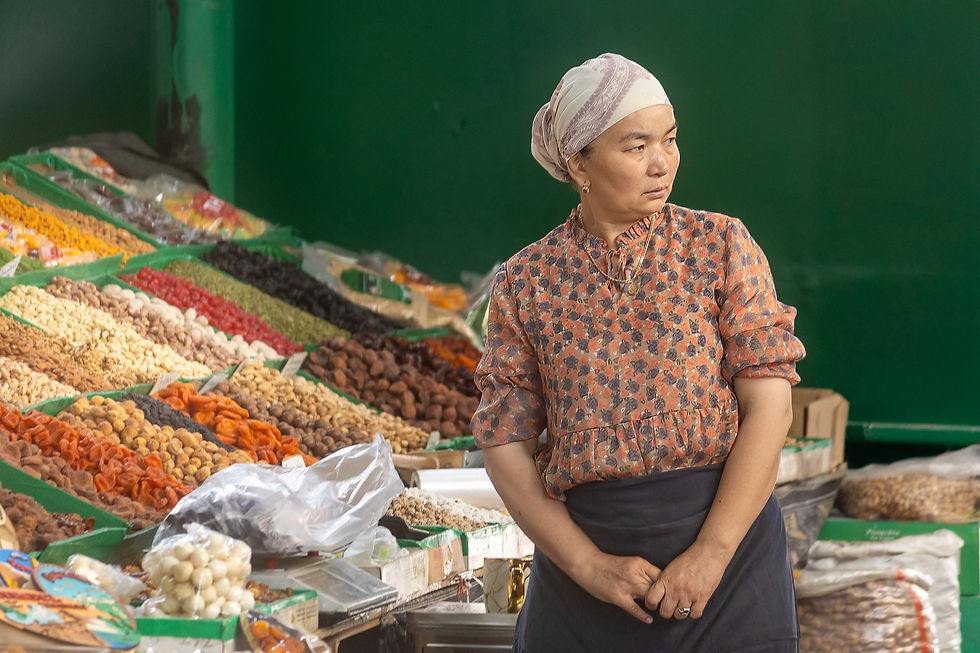
If you’re looking for something more chaotic, you can also visit Osh Bazaar—Bishkek’s version, not the one in Osh (which, as I learned, had recently closed). This one is very much alive: busy, crowded, and full of everything from produce to clothing to household goods. It’s less about sightseeing and more about stepping into the daily rhythm of the city.
We were there in summer, which meant the Opera and Ballet Theater was on break. But if you visit during the season, it’s absolutely worth checking the schedule. It’s one of those experiences that adds a different layer to your understanding of the city.
And if you’re willing to venture a bit farther, there’s a popular day trip to the Burana Tower, about an hour outside Bishkek. It’s a lone minaret rising out of the steppe, all that remains of an ancient Silk Road city. We skipped it, having already seen similar towers in Uzbekistan. But if your Central Asia itinerary doesn’t include places like Khiva, this is probably worth your time.
That’s really Bishkek.
Not a city of overwhelming “must-see” sights, but one that rewards a good walk, a bit of curiosity, and a willingness to simply sit down on the nearest bench and watch whatever may happen to occur in front of you.
How Long to Spend in Bishkek
You don’t need a lot of time in Bishkek.
If you’re a fast-moving traveler, you could see the highlights in a single day. Start at Ala-Too Square, do a loop through the main Soviet-era landmarks, wander a park or two, and you’ll come away with a solid feel for the city.
We, on the other hand, are not fast-moving travelers.
We spent four days in Bishkek, which was probably at least one day more than we needed. That’s not a complaint—Bishkek is a genuinely interesting place. It’s easy to walk, easy to navigate, and easy to settle into. If you dropped me there for a month, I would have no trouble filling the time.
But most trips come with limits.
And in Central Asia, there are places that demand more of your time—Samarkand, Bukhara, the landscapes of Kyrgyzstan beyond the capital. Bishkek works best as a gateway and a pause, not the main event.
So my recommendation would be to keep your stay relatively short. Give it a day or two. Take a walk, enjoy the atmosphere, eat well, and then move on.
Bishkek will be just fine without your staying longer.
And you’ll be glad you saved the time for what comes next.
Bishkek is not a city that tries to win you over.
It doesn’t overwhelm you with sights. It will probably not vie for the highlight of your trip to Central Asia..
But that is OK.
After a while, you start to appreciate the rhythm of the place. The ease of getting around. The parks. The way the city feels lived-in. It’s not trying to be anything other than what it is while remembering what it was—and there’s something refreshing about that.
Was it the most memorable stop on our trip?
Probably not.
But it was quite comfortable.
And that counts for more than you might think when you’re moving from place to place, constantly adjusting, constantly taking in something new.
Bishkek gives you a chance to pause. To reset. To enjoy a city without feeling like you’re missing something if you don’t see everything.
And then, when you’re ready, it lets you move on without making it complicated.
Which, in its own quiet way, makes it exactly the kind of place you want it to be.
Because travel isn’t always about the places that demand your attention.
Sometimes, it’s about the ones that simply make the journey better.


Comments