Across the Pamir Highway: Road Stories from the Roof of the World

Updated: Apr 12

The Landslide Brought Us Down
I shifted a bit, trying to get more comfortable. But you can only get so comfortable perched on a boulder at the edge of a small—but absolutely raging—creek. In fact, if I’m honest, after the first two hours sitting on that boulder, comfort had become more of an aspiration than an obtainable reality.
I had been sitting on that boulder for a while.
And I had no idea how much longer I would be there.
We were barely 24 hours into a nine-day epic journey along the Pamir Highway, the famed ribbon of (mostly) asphalt cutting through the mountains of Tajikistan and into Kyrgyzstan. It was just us, our driver, and the road.
So it was a bit of a bummer that the road was closed up ahead.
For how long?
Shrug.
“It will open soon.”
Note to self: “soon” is a word that can mean many things, possibly including “never.”

I love road trips.
I have always loved road trips.
Long before I started traveling internationally, I honed my travel skills loading up as a kid with my family and setting out to see the United States. My family drove all over the country, and I loved it.
I loved the gentle, almost comforting monotony of watching the scenery slip past mile by mile, scene by scene.
I loved the audiobooks.
The songs we would sing.
The quiet adventure of it all.
And the puzzle of finding good food each day in an unfamiliar place.
If you want to see the world, roll across it on wheels.
But road trips can be unpredictable under the best of circumstances. And a road through a developing country—across the roof of the world, through the great Pamir Mountains—is not exactly easy terrain on which to maintain infrastructure.
And so we were stopped. The road was closed.
Was it construction?
A landslide?
Construction that had caused a landslide?
A landslide that had necessitated construction?
Nobody seemed entirely sure.
But when you ride the Pamir Highway, you get to exercise patience.
And so I sat there, perched on a boulder by the creek. The fierce, churning water produced a blast of cool air as good as any air conditioner could have managed. That mostly made up for the fact that my butt had gone from uncomfortable, to numb, to alarmingly numb over the course of a few hours.
But, as we always say, everything always works out.

The Pamir Highway Origins
The Pamir Highway did not begin as a romantic road trip.
Like many great roads, it began as something far less glamorous: a logistical problem.
Long before there was asphalt—or even the idea of a highway—this region was threaded with rough routes that formed part of the Silk Road, the sprawling network of trade paths that carried silk, spices, horses, ideas, and the occasional plague between China, the Middle East, and Europe. Traders, pilgrims, and adventurers picked their way through these mountains for centuries, following valleys, passes, and whatever paths seemed least likely to get them killed.

But the modern road owes less to merchants and more to empire.
In the late 1800s, Central Asia—including what is now Tajikistan—was absorbed into the Russian Empire. At the time, the Russians were deeply concerned about the growing British presence in South Asia. This rivalry—often called The Great Game—was essentially a geopolitical chess match played across the mountains and deserts of Central Asia.
And as any military professional will tell you, amateurs talk strategy, professionals talk logistics.
If you want to move soldiers, you need roads.
If you want to supply those soldiers, you need better roads.
So the Russians began improving the region’s transport routes, though the truly modern version of the highway wouldn’t arrive until the 1930s, when the Soviet Union constructed a more formal road connecting Dushanbe in Tajikistan to Osh in Kyrgyzstan—both then comfortably inside the borders of the USSR.
Later, in the 1980s, the road received another round of attention during the Soviet war in Afghanistan. Moving troops, equipment, food, and ammunition across mountainous terrain requires a certain level of infrastructure, and the Pamir Highway became part of that logistical backbone.
Today the road is known officially as the M41 (although travelers stick with "Pamir Highway").
It remains a vital transportation corridor for the scattered villages and towns of the Pamirs.
But for travelers like us, it has become something else entirely: one of the most famous—and remote—road trips on Earth.
Which, of course, is exactly why we were there.
Building the Pamir Highway: a Road Across the Roof of the World
If driving the Pamir Highway today requires patience, building it must have required something closer to pathological stubbornness.
When the Soviets began constructing the modern highway in the 1930s, they were not working in forgiving conditions. The Pamirs are often called the “Roof of the World,” and like most roofs, they are not especially convenient places to build infrastructure. Much of the road runs at elevations between 3,000 and 4,000 meters (roughly 10,000–13,000 feet), where the air is thin, winters are brutal, and landslides have a habit of undoing yesterday’s progress.
The workers who built the road faced all of it.
Construction crews—soldiers, engineers, and laborers—spent years carving routes along steep mountain slopes, blasting rock faces, building bridges across raging rivers, and laying down gravel and asphalt in places where even breathing required effort. Machinery helped where it could, but much of the work was done the old-fashioned way: with explosives, shovels, persistence, and a tolerance for hardship.
Conditions were, by most accounts, extremely difficult. Supplies had to be hauled into remote valleys. Temperatures swung wildly between seasons. Entire stretches of road could be wiped out by avalanches, floods, or shifting mountainsides, forcing crews to start again.
In other words, the Pamir Highway was never simply “built” once.
It has always been negotiated with the landscape.
Even today, as we would soon discover while sitting on a boulder beside a raging creek waiting for the road to reopen, the mountains still reserve the right to remind humans who is really in charge.
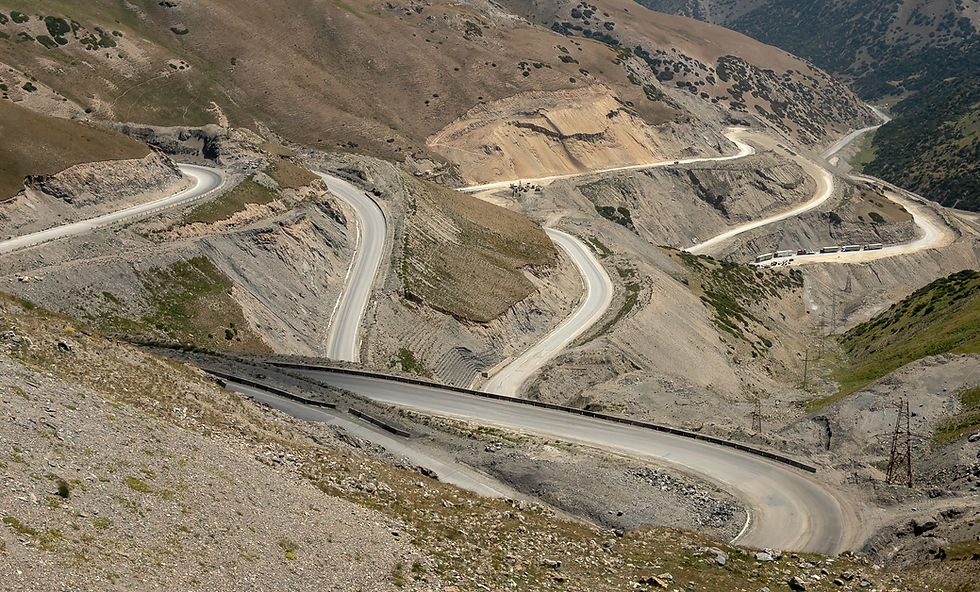
Setting Out from Dushanbe
We began our journey in Dushanbe, the leafy and slightly bewildering capital of Tajikistan.
Travelers can drive the Pamir Highway in either direction—Dushanbe to Osh, or Osh to Dushanbe—but most people recommend heading east, which is what we did. The logic is simple: both the scenery and the altitude build gradually as you move eastward, allowing the mountains to grow around you slowly until suddenly you are driving across the roof of the world.
It felt like the right way to do it.
One of the best general resources for travelers heading to Central Asia is Caravanistan, a wonderfully obsessive website devoted to travel in the region. If you are planning anything even vaguely adventurous across the old Silk Road lands, it is worth reading. Among its many useful pieces of advice was one recommendation repeated again and again:
Do not skimp on your car and driver.
This made sense. The Pamir Highway is not a place where you want mechanical surprises or a driver who treats mountain roads like a video game.
Following that advice, we booked a car and driver through Visit Alay, a Kyrgyz-based travel company that specializes in trips through the Pamirs. Our nine-day journey cost $2,000, not including hotels or food.

It was, by a wide margin, the most expensive single segment of our entire Central Asia trip.
But I was excited to climb into a car and spend the next week watching the landscapes of the Pamirs slide past the windows.
The basic itinerary was straightforward: Dushanbe to Kalaikhum, onward to Khorog, then east through the Wakhan Valley and onto the high Pamir plateau before eventually crossing into Kyrgyzstan and finishing in Osh.
But because we arranged the trip ourselves rather than joining a rigid group tour, the schedule was flexible.
Flexibility seems, at first, like a nice option.
In practice, change was not optional. Your schedule will change in the mountains. The only question is how much.
Day Two: The Road Quits on Us
And that is how we found ourselves, on the second day of the trip, sitting roadside with everyone else—tourists, truckers, local drivers, and the occasional confused goat—waiting for the road to reopen.
We had been stopped around 11:00 in the morning.
The original rumor was that the construction crews would soon break for lunch, and during that time traffic would be allowed through.
Nope.
Instead we lounged about for close to five hours beside a raging creek while the sun slowly arched across the sky and our carefully imagined schedule quietly collapsed.
Eventually someone shouted something in Tajik. Or maybe Russian. Definitely some language I do not know.
Drivers sprinted toward their vehicles.
Engines roared to life.
It was a mad dash as everyone piled into cars and trucks and surged forward toward the roadblock.
Of course, after racing forward for a few hundred meters, traffic stopped again.
And we all sat there for another half hour.
The “Death From Above Zone”
At one point I stepped out of the car and stood there, shading my eyes from the sun, staring at the small stretch of road we were all waiting to cross.
The section under construction was a narrow dirt ledge carved into the mountainside. On one side, brown-gray cliffs climbed steeply upward. On the other side, the ground simply disappeared into a raging river below.
It was the sort of road that makes you quietly contemplate your relationship with gravity.
As I stood there examining this thin strip of dirt that we were supposedly about to drive across, the cliffs high above the road suddenly belched out a mass of earth, stone, and violence.
Landslide!
The entire scene disappeared into swirling dust. Happily, no one was in the impacted area just then.
I watched the avalanche of rocks tumble down the slope and thought, quite calmly:
Well, that’s that. No crossing today.
I figured we would find some place on this side of the road to spend the night and try again tomorrow.
But apparently the Pamir Highway has its own way of solving problems: crossing its fingers and plowing forward.
Hardly had the dust cleared when a large truck with a plow attached to the front rumbled forward and simply pushed the newly fallen debris off the road.
Problem solved.
Cars began moving again.

The Sprint
Each driver approached the section the same way.
They would slowly creep toward the part of the road that I had mentally labeled “the death from above zone.”
Then they would pause.
Look up at the cliffs.
Take a breath.
And then floor the accelerator, racing across the unstable stretch of road as fast as possible.
Naturally, that is exactly what we did too.
Our driver rolled forward carefully, eased up to the edge of the danger zone, glanced at the cliffs above us—
—and then slammed on the gas.
The car surged forward.
Dust flew.
The river roared below.
The cliffs loomed overhead.
My skin crawled. I waited for the sky to fall.
But, I am very happy to report, no landslide came crashing down on us.
At long last we were past the roadblock.
Only half a day behind schedule.
Which, on the Pamir Highway, I consider an absolute victory.
My Most Surreal Game of Make Believe
One of our first stops on the Pamir Highway was at a desert fortress.
This fortress once guarded the western approaches to the Pamirs, watching over caravans and armies as they passed through the mountains. Today it is largely restored and houses a small museum.
We thought we were making a quick stop.
But oh no.
Not at all.
You see, we were the only people there. Possibly the only visitors that day. Possibly that week.
The curator—who also appeared to be the director, tour guide, historian, and maybe the mayor—came out to greet us personally.
And to show us the museum.
Personally.
There is something wonderful about people who are supremely passionate about something. It really is great to see.
But there are… diminishing returns on that passion for outsiders.
The king of the museum was proud of his kingdom, and he wanted to show it off. Every picture. Every artifact. Every story that could possibly be told was told.
To us.
For much longer than we had anticipated.
And the experience culminated in what may be the most surreal thing that has ever happened to me in a museum.
He led us to a glass display case and pointed proudly to a clay jar from the 10th century.
More than a thousand years old!!!
So I was understandably a little surprised when he pulled out a key, opened the case, grabbed the jar, and offered it to me.
“Take this.”
Um… what?
I looked around the room, certain this was some kind of sting operation. Surely the moment I touched the priceless artifact a swarm of cultural police would burst in, tackle me to the ground, and throw me into a damp stone cell forever.
He gestured again, more emphatically.
“Take it!”
So I reached out cautiously, and before I could reconsider my life choices he had thrust the ancient jar into my hands.
Then he said, “Now give me your phone.”
Um… what?
“Give me your phone! Turn on the camera first.”
So, carefully cradling a thousand-year-old clay jar in one hand, I reached into my pocket with the other and produced my phone, turning on the camera as instructed.
He took the phone happily and positioned himself to take a picture of me.
Was this going to be evidence at my trial?
Then he gave the instructions.
“Mamas would feed milk to their babies from this jar. You be a baby and pretend to drink milk.”
Um.
WHAT???
And so, in a state of discomfort I previously believed impossible, I found myself pretending to drink milk from an ancient piece of pottery while the man tasked with preserving the cultural heritage of this place happily photographed the moment.

And the strange thing is…
I was never arrested.
When the photo session ended, he carefully took the jar back, placed it in the case, locked the glass, and nodded with satisfaction.
And we went on our way.
Strange day.
The Subordinate of the Flies
One of the draws of the itinerary we chose was the chance to hike into a remote Pamir village called Jezeu and spend the night there.
Even though we were already a day behind schedule thanks to our roadside landslide adventure, we didn’t want to cut this part of the trip. So when we arrived at the trailhead we pulled on our overnight packs, left the rest of our luggage in the car, and started hiking up into the mountains.
The brochure said the hike would take two hours.
Which is probably true if you are focused on getting from point A to point B.
We took our time and it ended up being more like two and a half to three hours. Or maybe Three and a half hours. OK, it was almost five hours. But it was a lovely walk. The trail climbed gradually almost the entire way, following a creek as it wound deeper into the Pamirs.

Our driver would stay behind with the car, so before we left he gave us simple instructions.
“When you reach the village, find Gulha’s Guesthouse.”
In theory there were two guesthouses in Jezeu.
In practice, only one of them was operating when we were there.
There was no sign.
No booking desk.
No website.
You simply arrived in the village and asked someone for Gulha.

Which is exactly what we did.
The locals asked for the name of our driver, nodded knowingly, and ushered us toward the guesthouse.
The setup was simple.
The guesthouse consisted of a building with two large communal sleeping rooms. Inside were long wooden platforms—less like beds and more like oversized shelves—covered with blankets.
You just picked a spot, threw down your bag, and claimed it for the night. There were already a few travelers who had claimed spots when we got there, and several more would show up after us.
Happily, Michelle and I had brought inflatable sleeping pads, so in theory we were about to enjoy a night of exceptional comfort.

In theory. Maybe. We did become a bit concerned after spending a bit of time in the village.
Because of the flies.
Now, I have seen flies before.
But this was something else entirely.
These were Biblical swarms of flies.
The good news was that they were not biting flies.
The bad news was that they were everywhere.
If you sat still for more than two seconds, they would swarm you. They crawled across your face. Your hands. Your nose. Any exposed piece of skin.
And if there was food nearby?
Well.
Guess what it was seasoned with.
Yep, flies!
And while I try not to dwell on unpleasant realities, it did occur to me that the flies crawling across my plate of noodles had probably spent the earlier part of their day wandering through the piles of animal dung scattered all around.
So I handled the situation in the healthiest possible way.
I did not eat very much.
Which, of course, left me low on energy.
No problem, I thought. I would just walk down to the lake near the village and take a peaceful afternoon nap beside the water.
This plan failed almost immediately.
Because the moment I closed my eyes, I could feel the delicate tickle of dozens of tiny legs as flies enthusiastically explored my face.
This was clearly a no-nap zone.
Fortunately, flies observe a strict bedtime.
Once the sun went down, they simply vanished, and the village became peaceful again.
We slept well.
The next morning we ate breakfast—though “ate” may be overstating things slightly. I spent most of the meal walking briskly around the village holding my plate, hoping that movement would discourage the flies.
It did.
Kind of.
Eventually we shouldered our packs, hiked back down the trail to the waiting car, and continued our journey along the Pamir Highway.
So Close, Yet So Far
One of the most fascinating parts of the typical Pamir Highway route is that for several days the road runs along the Wakhan Corridor.
Which means that for days you are driving beside a river. Sometimes it is a roaring, glacial torrent. Sometimes it shrinks into something that looks almost gentle.
And on the other side of that river—sometimes so close you could throw a stone across it—is Afghanistan.

If you glance at a map of Afghanistan, you’ll see it: a long, narrow arm stretching eastward toward China, like the country reaching outward in defiance or longing. This is the Wakhan Corridor.
The Wakhan Corridor was not created by geography.
Like the Pamir Highway itself, the Wakhan Corridor was created by empire.
In the late nineteenth century, during the Great Game, British and Russian strategists wanted a buffer between Czarist Russia and British India. The solution was a narrow strip of Afghan territory carved through the mountains.
A buffer.
A boundary.
A compromise etched into the map.
Even today, Tajikistan and Pakistan do not quite touch each other, because Afghanistan’s Wakhan Corridor separates them.
I have never been to Afghanistan.
But I have developed a complicated set of feelings about the country.
A friend of mine fled Afghanistan as a young person after the Taliban issued a death threat against them. They built a new life elsewhere, but when they speak about the place they were born, there is always something unmistakable in their voice.
Not bitterness.
Not anger.
Love.
Longing.
When you hear someone talk about a homeland they cannot return to, you cannot help but feel something for that place too.
So when, a day’s drive out of Dushanbe, we reached the Panj River—a ribbon of glacial melt carving through the mountains and marking the border between Tajikistan and Afghanistan—I found myself staring constantly at the far bank.
Just across the water were villages. Afghan villages.
Children splashing in the river.
People working in the fields.
Men walking along narrow paths beside donkeys and goats.

On the Tajik side, the road alternated between asphalt and rough gravel. Power lines stitched their way across the hillsides.
Across the river, Afghanistan told a different story.
The road there was always dirt. No power lines crossed the hills. The villages clung to terraces along the riverbanks—simple houses built from stone and mud, glowing softly in the mountain light.
They were less developed, yes.
But there was a quiet grace to them.
And something else too.
Something harder to name.

Dreams of Crossing
Before the trip, I had entertained a romantic little fantasy.
I imagined finding some quiet, unobserved stretch of the river, slipping across the water, and briefly setting foot on Afghan soil.
In the 1960s and 70s, Afghanistan was a stop along the great Hippie Trail, the ultimate destination for young backpackers traveling overland to Asia.
Today, of course, that world is gone. Afghanistan is a no-go zone for all but a handful of aid workers. I knew it was a foolhardy wish, but I wanted to set foot on Afghan soil. To make a physical connection with the place, even if only for a moment.
But the Tajik border guards had other ideas.
While the Afghan side of the river often appeared quiet and mostly empty, the Tajik side was not. Soldiers carrying machine guns patrolled the road regularly.
There was never a moment where crossing the river would have ended in anything other than being shot, arrested, or both.
So, sadly but wisely, I stayed on the Tajik side.

Afghan Markets
Along the Pamir Highway there are several places where Afghan markets are occasionally held.
These markets are located on the Tajik side of the river, but Afghan merchants are allowed to cross the border temporarily to sell goods.
If you happen to be traveling through the region when one is operating, they are worth visiting. (Check schedules in advance if this is something you hope to see.)

We attended one in Khorog.
The market was lively and colorful, and my photographer’s instincts immediately kicked in.
Which, it turns out, was a mistake.
Within moments of pulling out my camera, a Tajik police officer approached me and politely but firmly explained that I should not photograph the police officers at the market.
Fair enough.
I put my camera down and tried again a few minutes later, this time focusing on some Afghan sellers.
Another officer quickly appeared.
No photos of them either.
At this point I realized I did not fully understand the rules governing photography at this particular market.
So I started being extremely careful about where I pointed my camera.
Which lasted about three minutes before yet another officer approached and said simply:
“No pictures. Put the camera in your bag.”

So I did.
Interestingly, while I was being repeatedly instructed to stop taking photos with my camera, my wife was wandering around happily taking pictures of everyone and everything with her phone.
No one said a word to her.
Travel lesson: sometimes the big professional-looking camera attracts attention that a phone does not.
Even without photos, we loved the market.
I bought a traditional Afghan hat, and we both picked up scarves from one of the vendors.
The Market That Wasn’t
Later we hoped to visit another Afghan market near Ishkashim.
This one was particularly intriguing because it sits on an island in the river. Technically, any part of the island beyond the midpoint of the river lies inside Afghanistan.
But when we arrived, stern men with machine guns politely turned us away.
Shortly before our visit, a group of Afghan sellers had slipped out of the market area and crossed illegally onto the Tajik side.
Security had tightened.
Tourists were no longer allowed in.
The Country Across the Water
Afghanistan today is a country in deep pain.
For women, for ethnic minorities, and for many others, the future feels tightly constrained.
But as we drove along the Wakhan Valley, watching those villages through the morning haze—seeing smoke rise from chimneys, children running along dusty paths beside donkeys, farmers working their fields beside the river—I felt something I did not quite expect.
Not despair.
Something else.
Life.
There is mystery here.
Beauty.
Strength.
And beneath the weight of history and the shadow of suffering, there is also resilience.
Afghanistan may be bowed.
But it is not broken.

The Fruits of Caravanning Are Alive and Well: Hitching a Ride
For centuries, Central Asia was not the destination.
It was the corridor.
Merchants, pilgrims, scholars, diplomats—all moved through these mountains along the braided network of paths that formed the Silk Road. Travel was constant. Movement was normal. And because travel could also be dangerous, people rarely moved alone.
They moved in caravans.
Temporary alliances of strangers heading in the same direction. Safety in numbers. Shared supplies. Shared information. Reduced risk.
The caravans would form and dissolve as people joined and left the group, depending on where they were headed.
And if you spend time on the Pamir Highway today, you realize something interesting.
The culture of the caravan never really disappeared.
It just changed vehicles.
You can see it everywhere in the form of hitchhikers.
Travelers—alone or in small groups—standing beside the road, arm outstretched, waiting for someone heading their way who might have a little space in their vehicle… and a little space in their heart.

The First Passenger
The first hitchhiker we picked up on the Pamir Highway was a small, older woman.
We saw her standing beside the road, and our driver explained that she was asking for a ride. Then he turned to us and asked if we minded if she joined us for a bit.
Of course we didn’t mind.
She was heading to a hospital in the next town over—not far away—and we were planning to drive straight through that town anyway.
So she climbed into the car with us.
We didn’t share a language, but we shared the road for a while.
She wasn’t the last local we picked up for a short stretch of the journey.
Out here, rides are simply part of how people move.

The Backpacker
But the most memorable hitchhiker we met was a young Korean woman we encountered climbing toward a high pass above the village of Langur.
She stood beside the road with an enormous backpack and an outstretched arm.
We stopped to talk with her.
She explained that she had read online that it was possible to travel the Pamir Highway independently—taking public transport to the major city of Khorog and then hitchhiking the rest of the route.
Which, technically speaking, is true.
After enduring a ten-hour shared taxi ride from Dushanbe to Khorog, she had spent the next two days hitchhiking her way east along the highway as far as Langur.
But from Langur onward, traffic becomes thin.
Very thin.
Most vehicles that pass through are already packed with passengers, luggage, supplies, or some combination of the three.
She had been walking uphill along the road for ten kilometers, trying to flag down a ride.
It turned out we were the first car with space.
So we picked her up and gave her a lift.
In the end, everything worked out for her.
But that may have been sheer luck.
The eastern half of the Pamir Highway sees far fewer independent travelers than the western side. The Korean backpacker had expected to meet other travelers along the road and join forces with them.
Instead, she mostly found an empty highway and big mountains.
Which, to be fair, is also part of the experience.

The Road Still Works
Watching hitchhikers along the Pamir Highway, it struck me how familiar the pattern felt.
A traveler sets out.
Another traveler offers a ride.
For a while, they move together.
Then the caravan breaks apart again.
Different destinations.
Different roads.
Different stories continuing on.
The vehicles may have changed.
But the old Silk Road instinct—to help the traveler heading the same direction—still survives out here in the mountains.
The Harrowing Towns of the Mighty Mountain Plains
There is a town along the Pamir Highway called Alichur.

How to describe Alichur?
Let’s just say Alichur is not a beautiful town.
It is not a hopeful town.
It is not a town where you linger, strolling charming streets while pondering life, or sit, sipping hot beverages.
Alichur is a town that sits on a high mountain plain being violently bullied by wind.
The wind never stops.
It does not slow.
It does not negotiate.
It arrives with the enthusiasm of a freight train and spends the day trying to remove anything not firmly bolted to the ground.
Even the mountains surrounding Alichur look worn down by the experience—rounded and smoothed as if centuries of relentless wind have slowly sanded the mighty Pamirs into submission.
The name Alichur is often translated as “Ali’s curse.”
The story goes that Ali, the son-in-law of the Prophet Muhammad, once passed through this region. Feeling the sting of the wind, he supposedly left a curse upon the place.
After stepping out of the car, I can report that this story feels extremely plausible.
Our driver pulled the car to a stop and I opened the door.
Immediately the wind slapped me in the face like an angry mountain spirit.
Still, bravely, I pushed forward into the gale, stepping into the street.
The buildings looked like whitewashed barracks.
No color.
No flourish.
Just squat structures crouching against the wind like soldiers waiting out artillery fire.
The walls surrounding each compound were built from the same pale coral stone as the surrounding plain—gray-white, dusty, and filled with quiet defiance.
Then my attention was drawn to the scene directly across the street.
Two men stood on top of a very large pile of dried manure disks.
Cow manure.
Or yak manure.
At this altitude, it could really go either way.
The disks had been laid out in the sun to dry and were now being stacked neatly—fuel for heating and cooking in a place where trees are about as common as calm, windless days.
This business did not do anything positive for the aroma of the town.
Nor did it help with the flies.

When the wind blew, the flies vanished.
But the moment the wind lessened—even briefly—they appeared as if from nowhere.
Where do they come from?
Where are they hiding during the wind?
Are they crouched behind rocks waiting for the signal?
I have questions. But no answers came. It remains a mystery to me.
From Alichur we eventually continued on to Murghab.
Which, to be honest, felt like more of the same.
Squat buildings.
Dust.
Wind.
Flies during the day.
And at night the flies politely step aside so the mosquitoes can take their shift.
Let’s just say you do not travel the Pamir Highway for the urban experience.
You come for the mountains.
And the road.
And the people.
And the strange, stubborn beauty of a place that makes absolutely no effort to charm you.
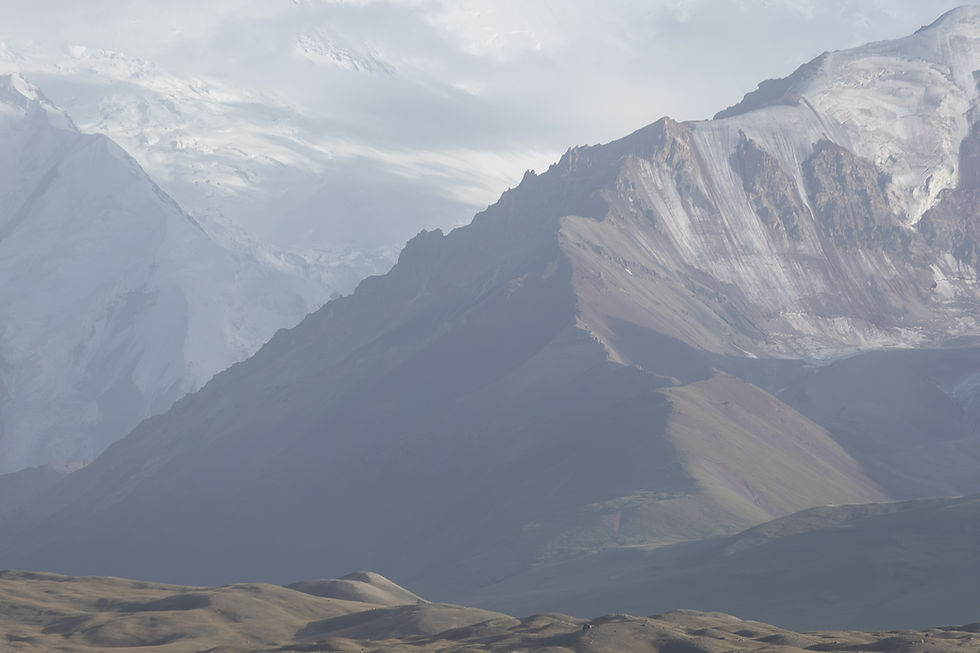
The Mack Daddy Luxury Suite of Tents
I know that “luxury” is not the word most people associate with the word tent.
But yurts are genuinely cool.
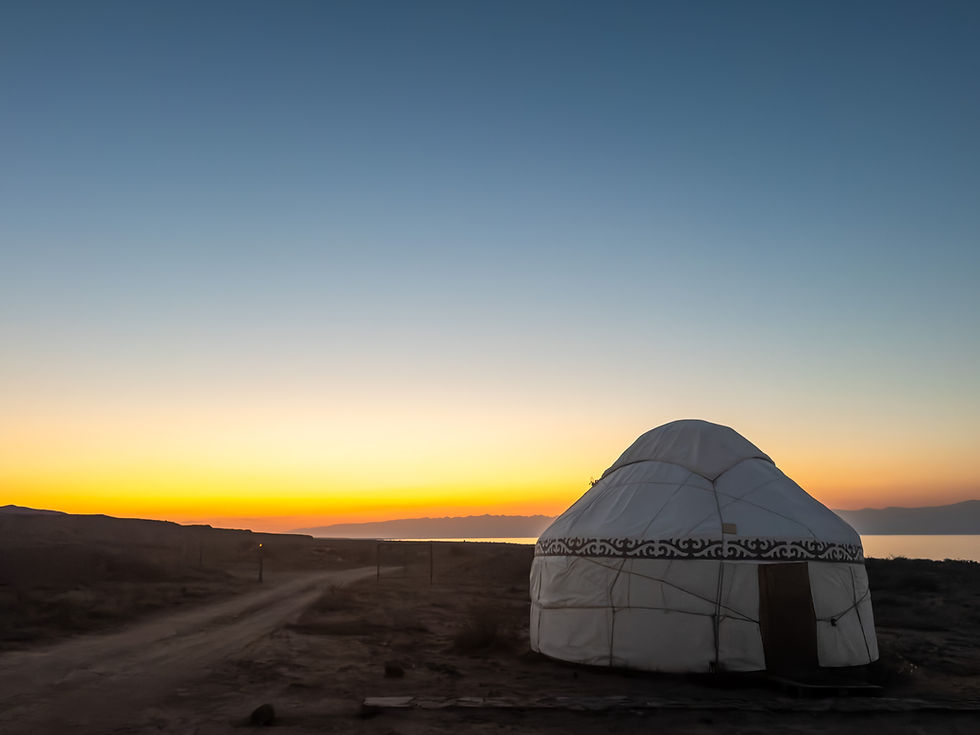
For centuries, yurts have been the dwelling of choice for the discerning nomad of Central Asia. They are marvels of practical design: a collapsible wooden lattice frame that expands into a circular structure, tightly wrapped with thick felt walls that keep out wind, rain, and cold.
And when I say wind, I mean serious wind—the kind of Pamir wind that tries to rip car doors off their hinges is barely noticeable to a yurt.
Yet when it is time to move on, the whole thing folds down into a surprisingly compact bundle.
Granted, it is not a tent you casually throw into a backpack.
But if you happen to have a caravan of horses, camels, or—more commonly these days—a few sturdy 4x4 trucks, a yurt becomes a remarkably portable home.
And a comfortable one at that.
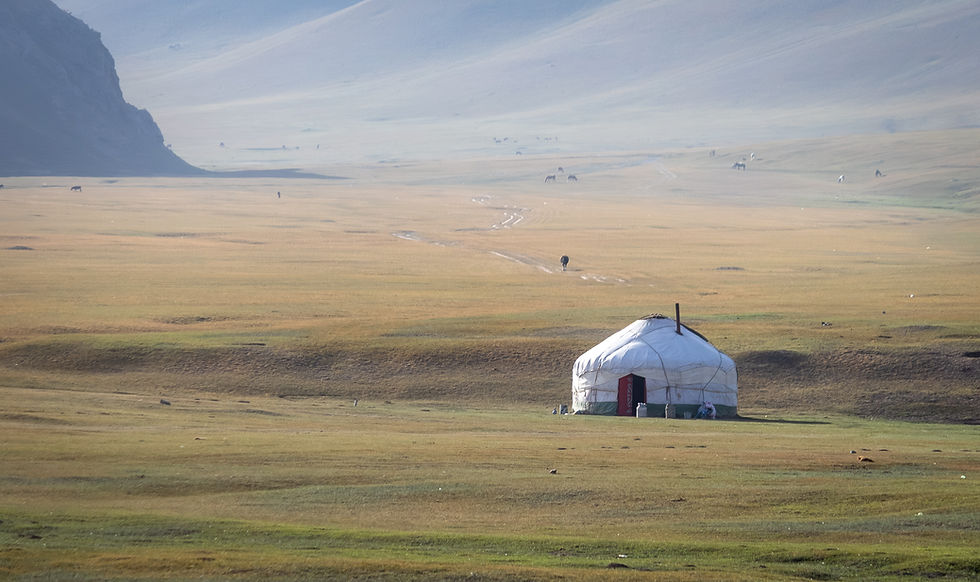
We stayed in yurts several times along the Pamir Highway, and they quickly became some of my favorite nights of the trip.
The most memorable one came during a very cold night high in the mountains of Kyrgyzstan.
To help keep us warm, the staff lit a small fire in the metal stove inside our yurt.

The fuel, naturally, was dried animal dung.
Which works extremely well.
In fact, it works too well.
Within about twenty minutes our yurt had transformed from “cozy mountain shelter” into something closer to a blast furnace.
But it turned out this was a wonderful problem to have.
We simply stepped outside, found a patch of grass (carefully checking for cow dung first), and lay down under the sky while our overheated yurt cooled off.
Above us, the Milky Way spiraled across the night sky, impossibly bright in the deep mountain darkness.
Not bad for a temporary home.

The Great Yurt Mystery
There was one mystery about the yurts that I never fully solved.
As we had already discovered, the Pamir Highway is a place of many flies and many mosquitoes.
At nearly every village and roadside stop, they appeared in enthusiastic numbers.
But for some reason…
They never came inside the yurts.
I expected that mosquitoes would inevitably find their way in and spend the night buzzing our ears and siphoning our blood.
But they didn’t.
Instead they behaved like very polite little vampires, refusing to cross the threshold of our dwelling without an explicit invitation.
Even the flies stayed out.
During our entire time in Central Asia, we never had to deal with insects inside a yurt.
Why?
No idea.
Perhaps the felt walls confuse them.
Perhaps the smoke from the dung stove keeps them away.
Perhaps yurts possess some ancient nomadic magic.
Whatever the reason, I am grateful.
Dinner in the Dining Yurt
Another highlight of staying in yurt camps is the communal meals.
Most camps have a separate yurt used as a dining hall. At mealtime everyone gathers there—travelers from whatever corners of the world have happened to converge on the Pamirs that particular evening.
Which usually means Europeans, with the occasional adventurous outlier.
The food is simple but hearty—soups, noodles, bread, tea—and the conversation tends to wander in interesting directions.
One evening we found ourselves sitting beside a family from Denmark.
This happened to coincide with a moment when the United States government was loudly floating the idea of somehow acquiring Greenland. By force if necessary.
Greenland, as you may know, is part of the Kingdom of Denmark.
So we spent a good portion of dinner apologizing profusely on behalf of our entire nation.
The Danish family was extremely gracious about the whole thing.
Which felt appropriate.
Because something about the Pamir Highway has a way of making people generous with one another.
Out there on the roof of the world, sharing a meal inside a felt tent, national politics start to feel very far away indeed.

Crossing the Border: Sidelined by the Internet
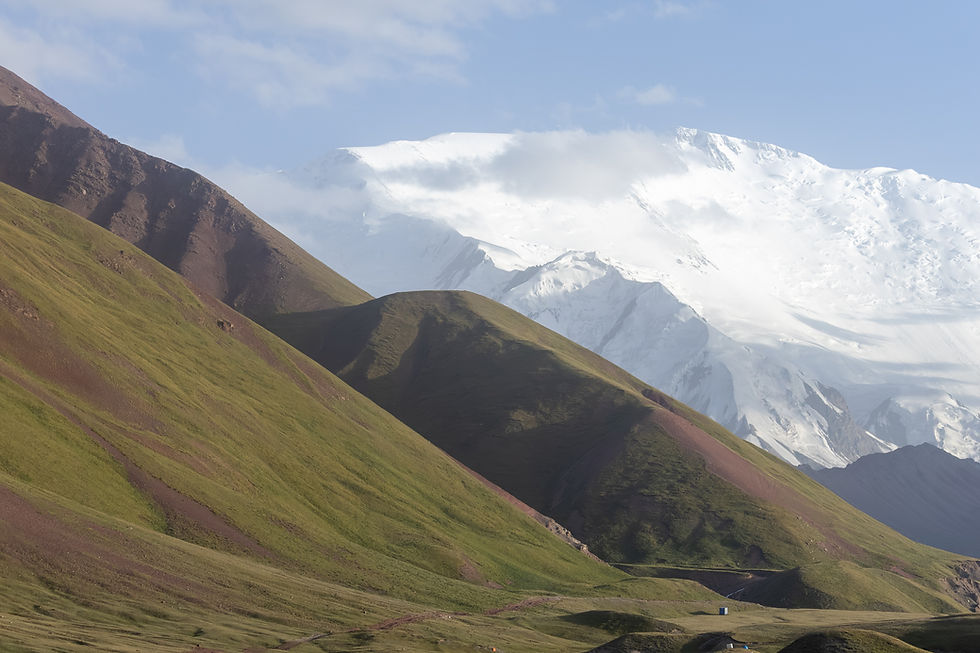
Some of the most beautiful scenery along the entire route in Tajikistan appears during the final climb toward the Kyrgyz border.
The mountains rise around you in impossible colors—shades of red, orange, and rust, streaked with purple and splashes of green.
They stand like sentinels guarding the frontier.
If you asked a small child to draw mountains, they would probably sketch those classic pointed triangles topped with snow.
Now imagine those triangles painted in deep reds and burning oranges, with streaks of purple running through them and patches of green clinging to the slopes.
That is what the mountains look like along the border between Tajikistan and Kyrgyzstan.

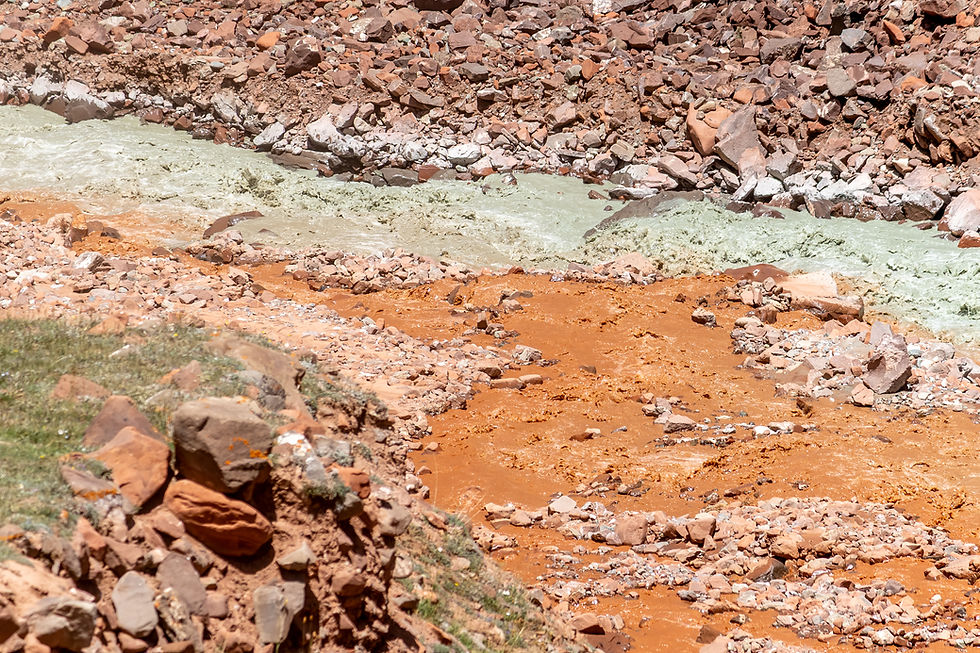
At one point we passed a place where two creeks came together.
One stream had been stained green by the terrain it flowed through. The other ran a deep rust-red, colored by the iron-rich rock higher up the mountains.
The two streams merged together in a swirling ribbon of color, the waters blending slowly as they continued down the valley.
It felt like a perfect metaphor for a smooth and harmonious border crossing.
Which is funny.
Because that is not what we got.
The Long Wait
Leaving Tajikistan itself was easy enough.
A few stamps.
A few nods.
And we were waved onward.
From there we drove through a long stretch of stunning no man’s land, the road winding through high mountains as we made our way toward the Kyrgyz checkpoint.
Then we arrived.
And discovered that the border was closed.
The internet connection at the checkpoint had gone down, and without it the border officers could not scan anyone’s documents.

So no one was crossing.
Bummer.
There was nothing to do but wait.
So we grabbed some snacks and a few extra bottles of water, climbed up the grassy slope beside the road, and stretched out in the grass.
And waited.
And waited.
And waited.
In total, we spent four hours lounging in the high mountain sunshine, watching trucks and travelers gather in a slowly growing line beside the silent checkpoint.
Eventually—mercifully—the internet came back to life.
Passports were stamped.
Documents were scanned.
The gate opened.

The Final Night
And just like that, we rolled into Kyrgyzstan.
From the border we continued onward to our yurt camp beside Tulpar-Kul, a mountain lake sitting in a breathtaking alpine valley beneath the towering peaks of the Pamirs.
It was the perfect place to spend our final night on the road.
The Pamir Highway had carried us across landslides, through desert towns, along rivers that separated countries, and over high mountain passes.
And now, at last, the journey was coming to an end.
Tomorrow we would drive on to Osh.
But for one more night, we were still out here on the roof of the world.
And that felt like a pretty good place to be.


Comments