Nuts and Bolts: Travel Tips for Visiting Dushanbe


Nuts and Bolts posts give you the practical information you need, but without stripping away the humor, mishaps, and little victories that make real travel what it is. These aren’t just guides. They’re how we actually did it—mistakes, triumphs, and all.
This page has some travel tips for visiting Dushanbe to aid in planning your own trip. I travel mainly with my wife, and we love to simply wander and eat when we explore a new place. We were in Dushanbe in July, 2025. If your trip to Dushanbe is significantly longer/shorter/with a different focus, you may have a very different experience.
The first time I ever heard the name Dushanbe was not in a geography class or a history book, but while watching Spies Like Us, as Chevy Chase and Dan Aykroyd nervously made their way to meet a shadowy contact on “the road to Dushanbe.” In my teenage mind, that firmly categorized Dushanbe as one of those vaguely dangerous, enticingly exotic places that mostly existed as a storyline.
Fast forward a few decades, and there I was—actually in Dushanbe.
It was… not what I expected.
Dushanbe is a large city, but not a mega-city. With about 1.3 million people, it’s significantly smaller than Tashkent, which has more than twice the population. And yet, Dushanbe feels enormous. That may be because you can’t throw a stone without hitting something monumental: a massive statue, an over-the-top fountain, a government building the size of a small nation, or a public space clearly designed to inspire awe, pride, or at least a bit of confusion.
Then night falls, and the city flips a switch.
Entire buildings light up in neon—blinking, pulsing, color-cycling through reds, greens, purples, and hues that do not exist in nature. Parts of Dushanbe look like a city-sized Christmas tree designed by someone who firmly believes subtlety is overrated.
We only had a couple of days in Dushanbe, which felt like barely enough time to scratch the surface of a city this strange, confident, and self-aware. It’s a place that doesn’t immediately explain itself—and that’s part of the charm.
What follows is a practical, nuts-and-bolts guide to navigating Dushanbe: how to get around, where to stay, what to eat, and how to make sense of a capital city that seems determined to leave an impression.
Travel Tips for Visiting Dushanbe: Weather

We were in Dushanbe in July.
It was freaking hot.
Not “pleasantly warm.”
Not “dry heat, so it’s fine.”
More like the kind of heat where you step outside and immediately start questioning your life choices, your travel planning skills, and whether human civilization was a mistake.
Summer temperatures in Dushanbe regularly climb into the high 30s°C (mid-to-upper 90s°F), and they do so with confidence. This is a city that sits in a broad valley, ringed by mountains that are beautiful to look at and utterly uninterested in providing shade. By midday, the sun feels direct, personal, and vaguely accusatory.
The saving grace—if you can call it that—is that mornings and evenings are slightly more forgiving. Early mornings are genuinely pleasant, and nights cool down just enough that walking around after sunset feels possible again, especially when the city lights up and fountains start spraying water with theatrical enthusiasm.
Spring (April–May) and fall (September–October) are widely considered the best times to visit. Temperatures are far more humane, the city is greener, and you can explore without constantly planning your day around air-conditioning breaks and hydration logistics.
Winter is cold but generally manageable, with occasional snow and crisp air—much better for walking, though less photogenic if you’re hoping for leafy parks and outdoor cafés.
Getting to Dushanbe
Dushanbe isn’t hard to reach—but it does like to make an entrance.
We arrived the most satisfying way possible: overland from Samarkand, via the legendary Road to Dushanbe (yes, that Road to Dushanbe). It’s not the fastest route, and it’s certainly not the most predictable, but it is scenic, affordable, and—once you pull it off—deeply satisfying.
From Samarkand (Uzbekistan):
There’s no reliable, frequent train between Samarkand and Dushanbe, and flights tend to be oddly expensive for such a short distance. Overland travel is the most common option. We took a car from Samarkand to the Panjakent border using the Yandex Go app, walked across the border, and hired a private car to take us the rest of the way to Dushanbe. The whole process was surprisingly smooth, reasonably priced (about $90US total for two people), and far less stressful than the internet might lead you to believe. (I wrote a full post breaking down this route step by step, because it deserves one.)
By Air:
Dushanbe International Airport has connections to regional hubs and a few longer-haul destinations. Flying makes sense if you’re short on time or coming from farther afield, but for nearby cities, it’s often pricier than expected.
Leaving Dushanbe (The Pamir Highway):
We didn’t linger long—because Dushanbe was our launch point for something much bigger. From here, we set off on a nine-day journey along the Pamir Highway. This is one of the most common reasons travelers pass through Dushanbe: it’s the natural starting (or ending) point for Pamir expeditions heading toward Khorog, Murghab, Osh, or back into Uzbekistan.
Most Pamir trips are arranged in advance through tour companies or local drivers, and Dushanbe is the easiest place to organize transport, permits, supplies, and last-minute logistics before heading into the mountains.

Getting Around Dushanbe
Getting around Dushanbe is easy enough—but it does require a small mental adjustment if you’ve grown accustomed to the comforting glow of ride-share apps.
When we were there, Yandex Go did not function in Dushanbe (a minor heartbreak after relying on it so heavily in Uzbekistan). Instead, the city runs on good old-fashioned taxis—and surprisingly, they’re not terrible.
Dushanbe has a large fleet of modern taxis, many of them electric, which feels oddly futuristic for a city that also has giant monuments to national poets and fountains the size of small lakes. Or medium lakes. Most taxis use meters, and fares are quite inexpensive by Western standards.
That said, you do lose some of the comforts that ride-share apps provide:
· You don’t always know the fare up front.
· Communication can be a challenge if you don’t speak Russian or Tajik.
· You may need to gesture, smile, and say your destination more than once. At one point,
I just gave the driver my phone and let him follow the directions on my Yandex Maps app to our destination. When we took taxis to our hotel, I always just gave the driver the name of a big, fancy hotel right around the corner from our hotel (drivers didn’t tend to easily recognize the name of our hotel, but they recognized the name of the fancy one).
In our experience, taxis were generally easy to find and quick to flag down. The one exception came when it took us 15–20 minutes to catch a ride—long enough to briefly question our life choices (it was hot), but not long enough to derail the day.
Overall, taxis in Dushanbe are perfectly workable, reasonably priced, and far less chaotic than taxis in many cities of similar size.
Still, the best strategy remains the same as almost everywhere: stay close to the sites you most want to see. Much of central Dushanbe is pleasant to walk, especially in the cooler parts of the day, and wandering on foot is often the best way to take in the city’s strange mix of Soviet planning, oversized monuments, and leafy green spaces.
In short: walk when you can, taxi when you need to, and don’t stress too much. Dushanbe will get you where you’re going—eventually.
Where to Stay in Dushanbe for the Budget Conscious Traveler
I wish I could give you a carefully curated list of wonderful hotels in Dushanbe.
I cannot.
What I can do—enthusiastically and with great confidence—is tell you where not to stay.
We stayed at the Green House Hostel, lured in by its reputation as a popular hub for travelers heading onto (or coming off of) the Pamir Highway. The logic was sound: lots of travelers, lots of shared information, lots of useful intel about border crossings, road conditions, and what snacks to hoard.
Reality, however, had other plans.
Our room was… smelly. And not in a vague, “maybe it’s the drain?” sort of way. This was a committed smell, one that had clearly signed a long-term lease. To this day, I could not tell you its source, only that it existed and that it wanted us to suffer.
Adding to the fun, the air conditioning barely worked. And since we were in Dushanbe in summer—when hot is less a temperature and more a philosophical condition—the AC managed only to keep the room from becoming actively hostile to human life. It did not, at any point, make the room cool. Or comfortable.
So we spent our time gently sweating, and wondering where that smell was coming from.
I’m sorry I can’t be more helpful in recommending where to stay. But if this post saves even one traveler from booking a smelly, barely air-conditioned room during a Dushanbe heatwave, then my suffering will not have been in (fully) vain.
What to eat in Dushanbe
Before arriving in Dushanbe, I had a hard time finding much useful information about where to eat—and once we arrived, it became clear why. Compared to other Central Asian cities we visited, Dushanbe’s food scene is quieter and less obvious. There aren’t clusters of must-eat restaurants or a clearly defined culinary core.
But that doesn’t mean eating here is bad. It just means you have to adjust expectations and be willing to stumble into places.
Dushanbe has a number of excellent cafés tucked into leafy residential neighborhoods, often set back from the street and shaded by trees. These places are relaxed, pleasant, and ideal for escaping the heat, even if they don’t advertise themselves as culinary destinations. Some of our best meals came simply from ducking into whatever café looked inviting and well-used.
We also leaned unapologetically on fast food and noodle joints, especially when the heat had drained all enthusiasm for decision-making. Sometimes the right travel choice is the one that involves air conditioning and carbohydrates.
For something more traditionally Tajik and regionally grounded, Rohat Teahouse is a solid choice. It’s a classic spot—popular with locals and visitors alike—and a good place to sample familiar Central Asian dishes in a setting that feels rooted in the city rather than aimed purely at tourists.
Dushanbe may not compete with Bishkek or Almaty when it comes to food, but it offers something different: meals woven into everyday neighborhoods, eaten slowly under trees, without much fanfare. If you approach eating here with curiosity rather than a checklist, you’ll do just fine.
What To Do in Dushanbe: A Walk Through Rudaki Park
We only had one full day to explore Dushanbe.
Which meant we had to make choices.
Dushanbe is a sprawling city filled with monumental architecture, massive government buildings, heroic statues, and fountains that appear to have been designed by someone who firmly believed that if a fountain is good, an enormous fountain is even better.
So we focused our time on the grand ceremonial heart of the city: Rudaki Park and the monuments that surround it.
If you only have a short time in Dushanbe, this is a good place to start. You can see many of the city’s most important monuments and public spaces in a single walk.
Start at the southern end of the park and work your way north.
Stop 1: The Monument of Ismail Samani

Begin near the National Library of Tajikistan, a huge modern structure with a broad plaza in front of it. The library itself is impressive—its pale stone façade stretches outward like a government building designed to house the knowledge of an empire.
But the real centerpiece here is the Monument of Ismail Samani.
If you are going to build a national monument, you might as well do it properly.
This statue honors Ismail Samani, the 9th-century ruler of the Samanid dynasty and a foundational figure in Tajik history. He stands beneath a towering golden arch, seated on a throne, holding a scepter and looking serenely out across the park.
The monument is enormous.
Golden columns rise overhead. A massive arch frames the ruler like a halo. At the base of the statue, sculpted lions guard the throne while symmetrical gardens and fountains stretch outward into the park.
It is exactly the kind of monument a young nation builds when it wants to remind both citizens and visitors that history runs deep here.
Walking Into Rudaki Park
From the Samani monument, walk north into Rudaki Park, the city’s central ceremonial park named after Rudaki, a 10th-century Persian poet often called the father of Persian literature.
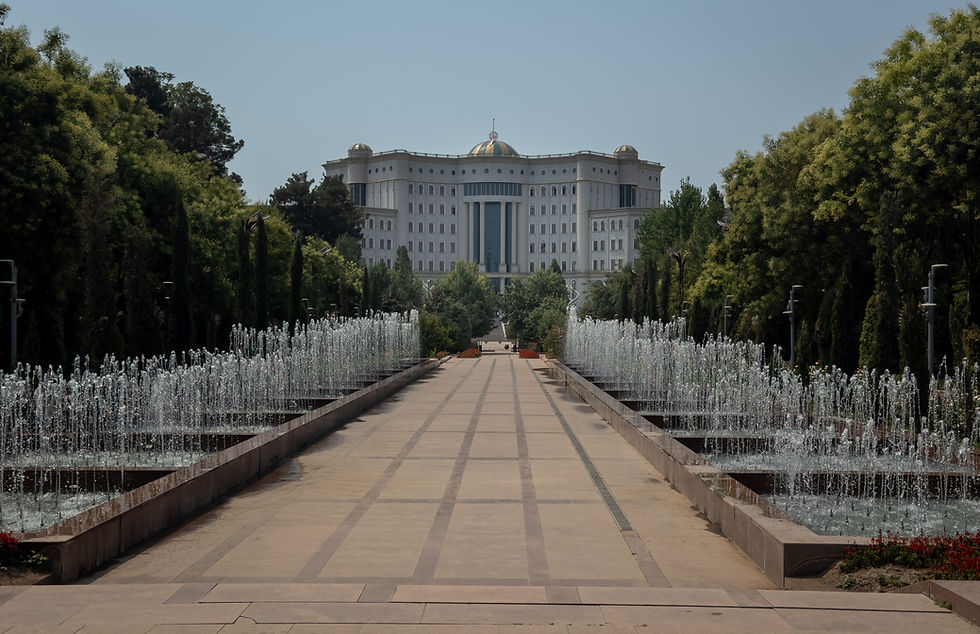
The park is beautifully landscaped—broad walkways, rows of trees, trimmed lawns, and fountains spaced throughout like punctuation marks in the landscape.
And Dushanbe really likes its fountains.
They are everywhere.
Some are elegant circular pools with small jets of water rising rhythmically. Others erupt upward in dramatic sprays, catching the sunlight and scattering mist into the warm Tajik air.
On a hot summer day—like the one when we were there—every fountain becomes an unofficial gathering place where families linger and children run through the drifting spray.
Grab an ice cream, pop a squat, and just take it all in.
Stop 2: The Flagpole of Tajikistan
Continue north and you will eventually see something towering over the park.
The Flagpole of Tajikistan.
For a time, this was the tallest flagpole in the world, rising more than 165 meters (over 540 feet) into the sky.
The Tajik flag—red, white, and green with a golden crown and stars—billows dramatically above the city, visible from far across Dushanbe.
Standing beneath it is a strangely humbling experience.
The pole itself is so tall that the flag seems almost detached from the ground, drifting high above the city like a floating symbol rather than a piece of fabric.
At the base of the flagpole are large plazas and decorative fountains, giving the entire space the feel of a national ceremonial ground.
Stop 3: The National Museum of Tajikistan
Just north of the flagpole stands the National Museum of Tajikistan, a grand modern building that looks as if it was designed to anchor the entire northern end of the park.
The museum houses exhibits covering the long history of the region—from ancient civilizations and Silk Road trade to the Soviet era and modern Tajikistan.
Even if you don’t go inside, the exterior is worth seeing. The building’s wide steps and symmetrical façade frame yet another series of fountains and gardens that continue the park’s theme of monumental public space.
From here you can look back south through Rudaki Park and see the line of fountains, gardens, and monuments stretching toward the golden arch of the Ismail Samani monument.
Dushanbe is not a city of subtlety.
Its public spaces are large. Its monuments are larger. And its fountains appear to operate under the philosophy that water sprayed dramatically into the air is always a good idea.
But if you only have a short time in the city, a walk through Rudaki Park offers a surprisingly compact introduction to the country’s history, symbolism, and national pride.
And it makes for a very pleasant way to spend a day wandering through one of Central Asia’s most unusual capital cities.
Leaving Dushanbe
We did not spend nearly enough time in Dushanbe.
In truth, we treated it mostly as a jumping-off point—a place to land, get organized, and begin our journey east along the Pamir Highway. One full day of sightseeing, and then we were gone.
And that’s a shame.
Because Dushanbe turned out to be a strange and surprising city. A place of enormous monuments and glowing fountains, of leafy parks and oversized national symbols, of neon-lit buildings that make the skyline blink and shimmer at night like a city-sized Christmas display.
It is not a place that reveals itself quickly.
I suspect it would take far more than a day or two to really understand the rhythm of the place—to figure out where the city hides its personality behind those monumental façades.
But that feeling is not uncommon when traveling.
In fact, it might be one of the great paradoxes of travel itself.
Because travel makes you how little you understand about the world. Every place you visit opens new questions, new curiosities, new directions you suddenly want to explore.
Travel doesn’t really satisfy curiosity. It multiplies it.
Which means that every trip ends the same way: with the quiet suspicion that you’ve only just begun to understand a place. And you need to go back.
Dushanbe certainly felt that way to me.
We arrived curious.
We left intrigued.
And I have a feeling I’ll need to return someday to see if I can figure the place out just a little bit better.



Comments