Transylvania Road Trip Itinerary: Castles, Cobblestones, and Carpathian Curves


I covered the basics of self-driving in Romania in a separate post. This one focuses on the specific Transylvania road trip itinerary I used. Transylvania is a region thick with medieval towns, fortified churches, and enough storybook charm to make even the most skeptical traveler wonder if the legends might have a point.
This was a short trip—just five days—and I didn’t spend more than one night in any one place. If you have more time, Transylvania rewards the slow traveler. You could easily start with this itinerary and stay longer in the places that seem the most interesting, or make additions for a longer trip. There are more rural villages, alpine trails, and friendly cats than I could possibly do justice to in a single swing through the region.
That said, this loop was a great solo trip. The overall pace was fast. But each morning was slow, with time for watching the sunrise, driving country “roads,” and just soaking it all in. Sunrise drone flights over fortified churches. Quiet walks through cobbled city centers before the bakeries even opened. No plan but the one I gave myself—and that changed depending on how the light looked.
Transylvania is steeped in myth—some of it earned, a bit of it exaggerated. But if you go wandering through the Transylvanian towns tucked into the Carpathian hills, you’ll quickly realize it’s not the vampires you need to watch out for. It’s the bears.
The Obligatory Transylvania Homework Section
You don’t need to show up in Transylvania with a PhD in medieval history, but having a little background makes the landscapes sharper and the landmarks feel more alive. Here are two themes that are worth brushing up on before you go:
Vlad the Impaler: Fact, Myth, and Marketing
Most travelers arrive in Transylvania with at least a passing familiarity with Dracula. What you may not realize is how thin the connection is between Vlad III, the 15th-century prince of Wallachia, and the vampire that bears his name.
Vlad—better known as Vlad Țepeș (the Impaler)—was a real historical figure. Born in the town of Sighișoara, he ruled with a famously brutal sense of justice, impaling thousands of enemies (and sometimes subjects) to deter crime and rebellion. His violence was legendary, but so were the political forces he was resisting—particularly the Ottomans and rival noble factions.
As for Bran Castle, which draws tourists as “Dracula’s Castle,” the connection is mostly speculative. Vlad likely never lived there, and maybe never even visited. But it looks like a vampire castle should look, and that’s all the tourism boards needed. Still, if you read a little about Vlad’s actual history—his shifting alliances, his reputation as both hero and monster—it adds nuance to the postcards.
So yes, you can still buy Dracula magnets. But knowing the real story behind the myth makes the region feel far richer than any tourist brochure.
But here’s the key: just because you know some history, that doesn’t mean you can’t let your imagination run wild. I knew there was little to no connection between Vlad and Bran Castle. I’d read the historians. I’d seen the footnotes. But standing there in the park in Bran at night, the lit-up castle towering above me like something pulled straight from a dream—I felt it. I felt every second of anticipation I’d had the first time I read Dracula as a teenager, that mix of dread and awe and possibility.
Knowing the truth doesn’t mean you have to be jaded. It means you get to hold both ideas at once: the documented past, and the emotional present. You can understand the propaganda, the political context, the exaggerations—and still get a chill down your spine when the wind moves through the trees. You can stand in the shadow of a fairy tale and know it’s not real, while still letting a part of yourself believe, if only for a moment. That’s not being naive. That’s just being open. And, honestly, life can be way more fin with this approach.

Fortified Churches: Faith Meets Defense
Scattered across the rolling hills of Transylvania are fortified Saxon churches, mostly built between the 13th and 16th centuries. These weren’t just places of worship—they were also community fortresses, built to withstand raids from the Ottomans and other invaders. The idea: when trouble came, the whole village could take shelter behind the church walls.
Most were built by Transylvanian Saxons, German-speaking settlers invited by Hungarian kings to stabilize and defend the region. Over the centuries, they constructed hundreds of fortified churches, many with concentric walls, watchtowers, and storerooms for food. Today, they’re among the most unique religious structures in Europe.
Some, like Biertan and Prejmer, are UNESCO World Heritage Sites. Others, like Viscri and Câlnic, offer a more rustic charm. But all of them share the same strange blend of sacred and strategic, humble and defiant.
They’re beautiful in the soft light of morning. And once you understand why a steeple might double as a lookout post—or why the pews are bolted to the floor—you start to see them not just as relics, but as reminders of how precarious life in a borderland used to be.

OK, let’s get to the road trip:
Step 1: Bucharest to Sibiu via the Transfăgărășan Highway
Assuming your road trip starts in the capital, Bucharest, if you want to get to Sibiu quickly, you should take the A1 motorway. It’s efficient, unremarkable, and gets the job done in about 4.5 to 5 hours, depending on traffic.
But if you’re here for the experience—and if you're reading this, you probably are—you’ll want to detour through the Transfăgărășan Highway. That will stretch the trip to 6.5 to 8 hours, depending on how many times you stop to gawk at the views, photograph bears, or sit in tunnel traffic wondering whether you’ve made a terrible mistake.

The Transfăgărășan doesn’t ease you in. Its lower slopes are heavily forested and frequently dotted with brown bears, lounging beside the road like oversized stray dogs. They’re everywhere. Don’t get out to pet them. Just admire from the safety of your vehicle—and maybe attempt a blurry phone video while driving by, managing a stick shift and dodging wandering drivers.
As you climb higher, the forest gives way to alpine switchbacks and glacial scenery, the kind of mountain landscape that feels too dramatic to be real. Near the summit is Bâlea Lake, where you’ll find parking, snack stalls, and hiking trails if you have the time and energy. In summer—the only season the road is open—it can get very crowded.
From there, the road begins its descent into Transylvania, eventually delivering you into Sibiu—one of the region’s most beautiful towns.

Sibiu isn’t a checklist city. It’s not about going from sight to sight. It is the sight. The old town is compact and walkable, full of pastel buildings, wrought iron balconies, and cobblestone streets that twist just enough to stay interesting. The rooftops are famous for their “eyelid” dormer windows, which give the impression that the city is watching you—or at least mildly judging your snack choices.
I had an afternoon, evening, and early morning in Sibiu, and that was enough for a once over of the town. I wandered, took photos, and watched the light shift over rooftops that looked like they’d been stolen from a storybook. No single attraction stands out. The town itself is the destination—and sometimes, that’s the best kind.
Optional Side Trip: West to Câlnic Fortress and Corvin’s Castle
If you’ve got extra time to spare, head west from Sibiu to explore one of the most scenic and underrated corners of Transylvania. This detour offers two very different stops: one small, quiet, and fortified; the other massive, theatrical, and straight out of a fantasy film.
Stop 1: Câlnic Fortress
Located about an hour west of Sibiu, the Câlnic Fortified Church is smaller than many of its UNESCO siblings—but what it lacks in scale, it makes up for in serenity. The stone towers and defensive walls rise out of the surrounding fields, and if you hit it at the right time of day, the light is phenomenal for photos. There’s usually no crowd, and you’ll have plenty of time to explore the towers, walk the perimeter, and appreciate the calm of a place that feels like it’s waited centuries for someone to stop and notice.
Stop 2: Corvin’s Castle (Castelul Corvinilor)
A bit over an hour beyond Câlnic brings you to Hunedoara, home of Corvin’s Castle—also called Hunyadi Castle. This is Transylvania’s most dramatic fortress, a towering Gothic-Renaissance behemoth complete with turrets, bridges, spires, and just enough actual history to justify its outrageous good looks.
If you tell a five-year-old to draw a castle, Corvin’s Castle is what they will draw.
It’s often used as a filming location and draws more crowds than Câlnic, but it earns them. Give yourself time to wander the interior halls, peer into the old prison, and get shots of the castle reflected in the moat—yes, there’s a moat.
If you make the full loop—Sibiu to Câlnic to Corvin’s Castle and back—you’re looking at around 4-6 (or more) hours of driving, not counting stops. It’s a full-day trip, but if you’re in it for castles, countryside, and contrast, this is an extremely satisfying way to spend it.
Step 2: Sibiu to Sighișoara, with a Stop at Biertan
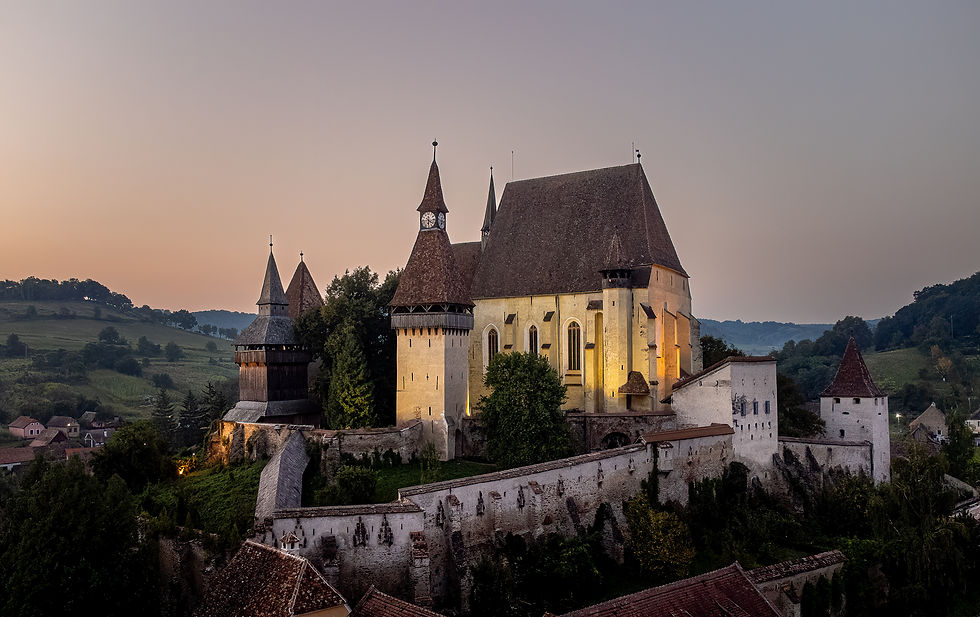
From Sibiu, I headed northeast toward the medieval town of Sighișoara. But I made one very important stop along the way: the fortified church of Biertan.
If you’re only going to visit one of Transylvania’s many fortified churches, make it this one. Biertan is everything you imagine when you think of an old Saxon stronghold—a walled church perched on a hilltop, overlooking a valley that looks like it was plucked from the pages of a fairytale. If you're lucky, and you're there early, patches of mist might drift through the town below, giving the whole scene an extra dose of magic.
I actually spent the night in Biertan, rather than Sighișoara, because I wanted to be flying my drone over the church at dawn. It was the right call for me—the photos I got that morning are some of my favorites from the entire trip. If photographing the church isn’t your main goal, you are probably better off staying in Sighișoara.
After my sunrise shoot, I continued on to Sighișoara, one of Romania’s most famously picturesque towns. The old citadel is a maze of cobblestone alleys, steep stairways, pastel buildings, and a clock tower that looks like it belongs in a pop-up storybook.
But here’s the thing: I was there in the middle of the day. And it was packed. Like shoulder-to-shoulder, camera-to-camera packed. Sighișoara is beautiful—I wish I could’ve appreciated it more. But I was so overwhelmed by the crowds that I didn’t enjoy it as much as other towns I visited, like Brașov.
Next time, I’ll probably spend the night in Sighișoara and give myself a chance to explore its streets at dawn, when the tour buses haven’t rolled in and the town can breathe a little. Even the most touristy places have their moments of quiet. You just have to time it right.
In terms of driving time, it will take you about an hour and a half (or a little less) to get from Sibiu to Biertan. Without traffic, it then takes about another half an hour to Sighișoara.
Step 3: Sighișoara to Bran, with a Stop at Viscri
Leaving Sighișoara behind, the road to Bran offers one more fortified gem before the vampire myths take center stage: Viscri.
Unlike Biertan, where you can practically park in the shadow of the church, Viscri makes you work a little. You’ll need to park in the village and make a short hike along a peaceful, forested path before the church comes into view. Viscri’s fortified church may not have the sweeping elegance of Biertan’s, but it more than makes up for it in atmosphere. The setting is quieter, more introspective. The kind of place where you can pause a while. Where the quiet crunch of gravel underfoot feels like part of the story.
From Viscri, the road continues on to Bran, perhaps the most polarizing stop on any Transylvanian itinerary.
The castle that looms above Bran is billed by the Romanian tourist authorities as Dracula's castle. The town is equal parts cheesy and spooky. But let’s get this out of the way: if you have no tolerance for sites with a healthy dose of myth-making and souvenir stalls, Bran might not be for you. But if you're good at letting your imagination run a little wild, this place can be a lot of fun. Yes, it’s crowded. But for me, the crowds in Bran felt more dispersed—less concentrated in one spot the way they were in Sighișoara. There was space to breathe and wander.
Bran Castle looms above the village, perched dramatically on its rocky outcrop. And while the connection between the castle and Vlad the Impaler is tenuous at best, the Gothic silhouette overhead still stirs something primal—especially if you, like me, first encountered Dracula on the page as a teenager and have never quite let go of that sense of haunted wonder.

If you’re lucky, you might stumble across the nameless little food stand dishing out chopped roasted pastrami with hearty bread and sharp pickles. It’s rustic, satisfying, and unforgettable—the kind of meal that tastes like it came straight from someone’s backyard grill.
And a final note of practical (and slightly thrilling) advice: if you stay the night in Bran, close your hotel gate when you come home late. Bears roam through Bran on a semi-regular basis. Because in Transylvania, it’s not just the stories that have teeth. Rope street is adorable (especially early when there will be no one on it but you) and the Black Church is everything a gothic church is supposed to be: authoritative, intimidating, and just a touch scary.
Step 4: Bran to Brașov
The drive from Bran to Brașov is short—just about 30 minutes. And many travelers treat Bran as nothing more than a day trip from Brașov. But let’s be honest: what’s the point of visiting a vampire’s castle only in the daytime? If there’s ever a place where the night holds more intrigue than the day, it’s Bran. That’s why I recommend doubling your time in this region: spend one night in Bran to soak up its shadowy charm, and another in Brașov, a city that’s just as delightful in the daylight.
And Brașov really is a delight. It’s one of my favorite cities in Europe—the kind of place that seems perfectly poised between large town and small city. Just enough happening to keep you engaged, not so much that you feel overwhelmed.

Wake up early and hit the streets: the old town is best explored before the day’s tour groups arrive. The cobbled lanes and pastel buildings are especially beautiful in the soft light of morning, when they feel like they belong to you and you alone. Rope Street is billed as Europe’s smallest street, and it is charming—when you don’t get stuck in the middle buy opposing tour groups trying to move past each other. Standing along in front of the Black Church, it is everything a gothic church is supposed to be: a little bit cute; a little bit intimidating.
If you still haven’t had your fill of fortified churches (and no judgment if you haven’t—they’re addictive), take a side trip out to Prejmer. Its massive circular walls and layered defensive features are some of the most impressive in the region.
For something with a little altitude, ride the cable car up Mount Tâmpa, where sweeping views spill out over Brașov’s red-tiled rooftops and beyond. It’s a great way to get perspective on the city—literally and figuratively—before heading on to the final stretch of your Transylvanian loop.

Step 5: Goodbye, Transylvania (But One Last Castle First)
As I mentioned, if you want to do Brașov justice, set your alarm early. There’s something magical about a quiet morning in the old town—just you and the cobblestones before the city wakes up.
After that, it’s time to say goodbye to Transylvania—but not without one final, very worthy detour.
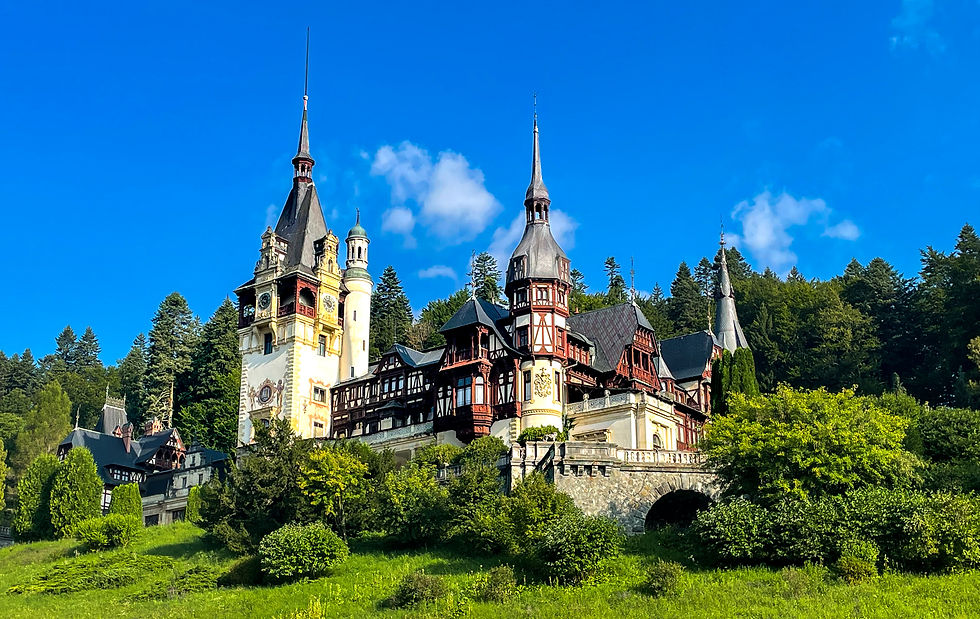
The drive from Brașov to Bucharest takes about 3 hours by the fastest route, but there’s no reason to rush it. On your way out of the Carpathians, you’ll pass right by Peleș Castle, and it would be a waste not to stop.
Technically located in Sinaia, and just outside the boundaries of Transylvania, Peleș Castle feels like the refined cousin to the moody, brooding castles elsewhere on the loop. Where Corvin’s Castle conjures war rooms and torch-lit intrigue, Peleș Castle brings to mind ballroom dances, royal tea, and powdered wigs. Built for King Carol I in the late 1800s, it’s as opulent as any palace in Europe, with stained glass, carved wood, and more turrets than strictly necessary.
The castle is just about 1.5 hours from Brașov and then another 1.5–2 hours from there to Bucharest, depending on traffic (and yes, traffic heading into Bucharest can be a beast).
But it’s worth it—for one final storybook stop before your journey ends.
Final Thoughts: A Road Well Wandered
Transylvania is more than just a place—it’s a mood, a myth, and a thousand unexpected turns down country roads. It’s fortified churches lit by morning mist, cobblestone towns watched over by curious-eyed windows, and brown bears napping beside switchbacks. It’s the quiet thrill of driving solo through mountain passes, drone in the trunk and history in the air.
This loop barely scratches the surface of what the region has to offer, but it still manages to take in its heart: the balance between the haunted and the hospitable, the grand and the grounded.
It’s the kind of trip that reminds you that seeing the world isn't just about checking off landmarks. It's about moments you didn't expect—chasing light, dodging crowds, watching out for bears—and letting a region's rhythm shape your own.
Because travel isn’t just about where you go. It’s about how those places move through you long after you’ve gone.


Comments