Nuts and Bolts: Travel Tips for Visiting Issyk Kul

There is something deeply unsettling—in the best possible way—about a lake so big you can’t see across it.
If you asked me to close my eyes and picture a lake, I would come up with something manageable. Something contained. A body of water that, with enough determination and questionable judgment, I could probably swim across without putting my life at serious risk.
That’s what a lake is supposed to be.
Finite. Knowable. Bounded.
And then you find yourself standing on the shores of Issyk Kul.
And the far side… isn’t there.
Just a thin, sharp line on the horizon. Blue on blue. Water stretching out until your brain quietly gives up trying to process it.
Wait . . .
That’s a lake?
How?
Because this isn’t how lakes are supposed to behave.
This is freshwater with oceanic energy. Waves that roll in with purpose. A horizon that feels like it belongs to something much larger. Something that refuses to fit neatly into the category your mind has prepared for it.
Because Issyk Kul isn’t just big.
It’s influential.
The lake has its own kind of gravity—not the kind that pulls objects downward, but the kind that draws life toward it. Towns gather along its edges. Roads bend to follow its shoreline. Entire rhythms of life seem to orient themselves around this vast, blue center.
And for travelers, that gravity works in your favor.
Some of the best cultural experiences in Kyrgyzstan—quiet villages, yurt stays, long walks along empty stretches of shore, moments that feel both expansive and oddly personal—are all pulled into orbit around this lake.
Issyk Kul doesn’t just dominate the landscape.
It shapes everything around it.

Planning Our Trip to Issyk Kul
There is a lot you can do around Issyk Kul.
Which, as it turns out, is both a blessing and a problem—because it means you have to make decisions.
We started, as all good travel plans do, with strong opinions and very little actual knowledge. The north shore looked developed. Resorts. Crowds. The general sense that someone, somewhere, might try to hand me a menu with laminated photos.
Not our vibe. Or at least not what we were looking for.
So we confidently decided: south shore.
This is the part where the plan briefly became ambitious.
The original idea was to go all the way to Karakol, on the far eastern edge of the lake, and then slowly work our way back. It’s a classic route. Very sensible. Very well thought out.
There was just one problem.
Karakol is far.
Not necessarily in kilometers, but if you are riding in a shared mini-van, every minute counts. And if you decide to skip the crowded marshrutka and hire your own car and driver, every minute costs.
And its main appeal is that it serves as a gateway to some of Kyrgyzstan’s best mountain trekking. Which sounds fantastic—if you are, in fact, planning to trek into the mountains.
We were not.
More specifically, my wife—who is generally very supportive of my ideas—had already experienced her personal quota of high-altitude adventure on the Pamir Highway. She had seen the mountains. She had appreciated the mountains. She was, at that point, quite content to admire mountains from a comfortable distance that did not involve hiking boots or oxygen considerations.
So Karakol, while lovely, no longer made sense.
Which is how we arrived at a revised plan that felt both practical and, frankly, a little more aligned with our current level of ambition.
We would go as far as Bokonbayevo.
Still on the south shore. Still surrounded by beautiful scenery. But several hours closer to Bishkek and requiring significantly less commitment to the idea of “effort.”
The plan was simple: spend a few days in the town of Bokonbayevo, and then move out to a yurt camp right on the lake for a few more days.
Which, at that point in the trip, sounded exactly like the right amount of adventure.

Community-Based Travel (CBT) in Kyrgyzstan
One of the best things about traveling in Kyrgyzstan is how easy it is to connect with local communities—and a big part of that is through Community-Based Tourism (CBT).
CBT is exactly what it sounds like: a network that connects travelers with locally run services—homestays, yurt stays, transportation, guides, and cultural activities. Instead of everything being funneled through large companies or outside operators, the experience is organized at the community level.
In practical terms, most towns and cities (including Bokonbayevo) have a CBT office. You can usually find them online and reach out via email or, even better, WhatsApp. Tell them what you’re interested in, and they’ll help arrange it—rides, activities, places to stay, or some combination of all three.
But the real value of CBT goes beyond logistics.
The idea is that the money you spend stays in the community. It supports local families, helps maintain traditions, and creates incentives for people to preserve the cultural experiences that travelers come to see. It’s tourism that, at least in theory, works with the community rather than around it.
For our trip, we used other platforms to book our hotel and yurt stays. But for transportation and all of the cultural activities we did (more on those below), CBT was our go-to—and it worked seamlessly.
It’s not just a convenient option.
It’s a better way to experience the place you came to see.

Getting from Bishkek to Issyk Kul (South Shore / Bokonbayevo)
Getting from Bishkek to the south shore of Issyk Kul is fairly straightforward.
How comfortable you want to be while doing it is another question entirely.
Your two main options are a marshrutka (shared minibus) or a private car.
Let’s start with the marshrutka.
They are cheap. Very cheap. And they go where you need to go. If your primary goal is to protect your budget, this is your move.
Just be prepared for the experience.
Marshrutkas can be… full. Not “all seats taken” full. More like nuclear-fusion-might-occur-between-me-and-this-random-stranger-I-am-currently-bonded-to-at-the-atomic-level full. Personal space becomes a theoretical concept. Limbs overlap. Bags are stacked in ways that defy physics.
It’s all part of the adventure.
And it’s absolutely what we would have done in our youth.
But we are no longer in our youth.
Which, as it turns out, mostly means we now have more money and less cartilage.
So we opted for a private car and driver.
We arranged it through the Bokonbayevo CBT office via WhatsApp, which was easy and efficient. The cost was 8,000 som—definitely expensive, but for us, absolutely worth it. Door-to-door, no contortion required, and the ability to stop when needed felt like a luxury we were happy to pay for.
The drive itself takes about 4.5 hours, give or take.
And it’s not exactly a smooth cruise.
There’s a fair amount of construction, with long stretches of gravel mixed in with paved road. As you get closer to the lake, the road starts to wind more, switching back and forth between asphalt and dirt like it hasn’t fully made up its mind what it wants to be.
Along the way, you’ll pass donkeys, construction equipment, and a surprising number of hitchhikers. It seems to be a perfectly normal way to get around here. Our car, however, was already full—with just the two of us and our bags—so we didn’t pick anyone up.
In the end, both options will get you there.
One will save you money.
The other will save your dignity.
Choose accordingly.

Where to Stay Near Bokonbayevo
We split our time between a guesthouse in town and a yurt camp on the lake, which turned out to be a nice combination—one part “functional base,” one part “this is why we came to Kyrgyzstan.”
Our first stop was Eco Resort Kaiyrma, just outside Bokonbayevo.
It sits up on a rise above town, which means you get fantastic views—of the mountains . . . the lake is not visible. Rooms consist of simple wood cabins, more permanent, but not much more equiped, than a yurt. You come here for the fantastic view over town. If you have a car, there’s plenty of parking. If you don’t, it’s about a 30–45 minute walk into town, or you can have them call you a taxi. Rides between the lodge and town typically run about 200–300 som (in summer 2025).

After a few days, we moved to a yurt camp.
Because if you’re coming all the way to Kyrgyzstan and don’t stay in a yurt at least once, I’m not entirely sure what you’re doing.
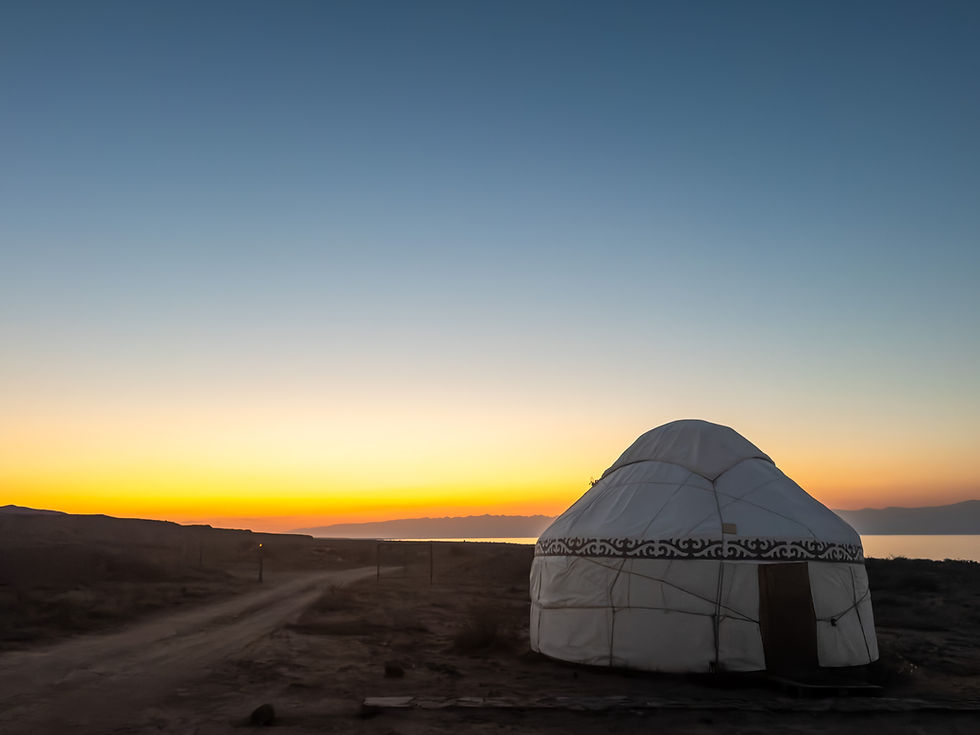
We stayed at Feel Nomad Yurt Camp, which sits out between Ak-Sai Canyon and the lake. Getting there is part of the experience. The road drops down through a canyon with scenery that reminded me a lot of Skalla Canyon—beautiful, a little rugged, and definitely not paved. You probably don’t need a 4x4, but you do need to take it slow.
We paid 2,000 som for a transfer from Bokonbayevo.
At the time, I thought we were getting ripped off.
And then I saw the road.
Turns out, we were not getting ripped off.
The camp itself is in a fantastic location—open, quiet (mostly), and right near the water. They have kayaks and paddle boards you can use, and they can arrange activities like eagle hunting demonstrations (we didn’t do this through the camp, so I don’t know the price).
Food at the camp was solid. Nothing fancy—lots of plov, meat, vegetables, and grains—but for a remote yurt camp, it was more than respectable. Breakfast was included, and lunch and dinner were about 800 som per person—and there isn’t really anything else nearby, so unless you are mobile (or fasting) you will likely do all meals at the camp.
When it was time to leave, Feel Nomad arranged a car back to Bishkek for 8,500 som. Slightly more than what we paid coming out (8,000 via CBT), but given that the camp is about 13 km down a dirt road, it felt reasonable.
A couple of practical notes: there is no Wi-Fi at the camp. We occasionally got a faint hint of data, but not enough to rely on. If you come here, plan to be offline. Electricity was available throughout the day, and there were hot showers, so you’re not exactly roughing it.
And then there was our final night.
It was about 9:00 p.m. A group arrived, set up a barbecue directly outside our yurt, and began blasting aggressively bad techno music from a portable speaker.
Loud. Persistent. Impressively committed to the bit.
Most of the time, it’s peaceful and quiet and feels like the middle of nowhere.
And sometimes… it’s not.
What to Do Around Bokonbayevo
The city itself is not much to look at. It is the surrounding areas you want to see.
Eagle Hunters

One of the highlights of our time around Bokonbayevo was seeing the eagle hunters.
This is a traditional practice where trained golden eagles are used for hunting—something that has been part of life on the Kyrgyz steppe for generations. It’s both a skill and a cultural tradition, passed down and still very much alive in this part of the country.
We saw eagle hunters several times during our week in the area, often arranged through CBT or local contacts.
It’s one of the most memorable experiences you can have around Issyk Kul.

Nomad Games
Another highlight of our time around Bokonbayevo was seeing versions of the nomad games.
These are traditional competitions—horseback wrestling, mounted tug-of-war, and other events—that trace their roots back to the training and culture of Central Asia’s cavalry-based societies. They’re not just games; they’re a reflection of a way of life built around horsemanship, strength, and coordination.
We had the chance to watch several of these during our time in the area, usually arranged through local contacts or CBT.
They are equal parts impressive, chaotic, and deeply tied to the history of the region—and they’re not something you’re likely to see anywhere else.

Horseback Riding
If there is one activity that feels completely at home around Issyk Kul, it’s horseback riding.
Horses are woven into the history and culture of Kyrgyzstan in a way that goes far beyond recreation. This is a place where mobility, identity, and tradition have long been tied to life in the saddle. What you’re doing as a traveler is just a small, modern echo of something much older.
There are a lot of ways to experience it.
You can do multi-day treks through the mountains, spend hours riding across high pastures, or even combine it with experiences like visiting eagle hunters. The range goes from “gentle introduction” to “you now live on this horse.”
We opted for something on the gentler end.
We arranged a two-hour ride with our yurt camp, which cost 1,000 som per horse plus 3,000 som for a guide—5,000 total. Our route took us up into a narrow dirt canyon for about half an hour, before looping back out through scrubland and returning along the lakeshore.
It was a really fun way to see the area.
And, importantly, just the right amount of effort.

Daytrip to Skazka Canyon and the Barskoon Waterfalls
One of the easier ways to explore the area around Bokonbayevo is to hire a car and driver for the day.
We arranged ours through the Bokonbayevo CBT office for 5,000 som, which gave us the flexibility to move at our own pace and hit a couple of the more popular spots: Skazka Canyon and the Barskoon waterfalls.
First stop: Skazka Canyon.

It’s pretty. No question about that. The rock formations are colorful and layered in interesting ways, and if you get the right light, I can imagine it being quite striking.
But . . .
If you’ve spent time in places like the US national parks in Utah, this is not going to blow your mind. And when we visited, it was absolutely packed. People everywhere. The kind of crowd where you start to wonder if there’s a second, less-advertised canyon nearby that you should be visiting.
We arrived around 10 a.m., which, in hindsight, was probably not ideal. If I were doing it again, I’d aim for very early morning or later in the afternoon—though I’ll admit that’s more of an educated guess than hard-earned wisdom.

After jostling our way through the canyon for a while, we headed to the Barskoon waterfalls.
At the trailhead, you’ll find a slightly unexpected feature: a memorial to Yuri Gagarin, because apparently the first man in space also has ties to this valley.
There are three main waterfalls you can hike to.
To reach the first, take the clear path to the right of the yurts. It starts off fairly steep, but it’s short. You’ll come to a fork—take the right path, and you’ll reach a two-tiered waterfall.
It’s… fine.
Nice enough. Maybe worth the short effort. Not life-altering. Very crowded.
To get to the second waterfall, head back to the fork and continue along the slope. If you’re there at the right time of year, you’ll pass fields of edelweiss, which is a nice bonus.
The third waterfall requires a much steeper climb above the second.
We were there around midday in August.
Which means we were also there with everyone else.
By that point, the crowds were so thick that continuing didn’t feel worth it. The spectacle had shifted from the waterfalls themselves to the sheer number of people trying to see them.
And while I always enjoy a good waterfall…
I’m less enthusiastic about a crowd that could qualify as a natural feature in its own right.
“Birds of Prey” Festival
We also attended something called the “Birds of Prey” festival.
“Festival” might be overselling it a bit—it’s essentially a cultural show put on for visitors—but it’s a very efficient way to see a lot in a short amount of time.
We booked ours through the Bokonbayevo CBT office, who handled both the tickets and transportation. Entry was 2,500 som per person (lunch included), plus a bit extra for a shared minivan to the site.
Think of it as one-stop shopping for the region’s greatest hits.
We saw eagle hunters in action, watched versions of the nomad games, sat through traditional music and dance performances, and even got a demonstration of how to put up and take down a yurt. It’s all curated, timed, and presented in a way that makes it easy to take in.
Is it a bit staged?
Yep.
But it’s also engaging, well-organized, and a great introduction to traditions that are very real—even if here they’re packaged into a more convenient format.
If you don’t have the time (or inclination) to track down each of these experiences individually, this is an easy way to see them all in one place.

In the end, our week in Bokonbayevo and the yurt camp was too much. We got a bit bored. And while we did enjoy our time in the yurt camp, it didn’t quite compare with the ones we stayed at on the Pamir Highway. The eagle hunters and nomad games were the clear highlight for us. I would say that if you contact the CBT and plan well, you could do this region justice in just a few days. But because travel is often a game of chance, we over-invested in time here.


Comments