Kok Boru: Yes, It's Played with a Dead Goat


Where Did a Game Like This Come From?
For just a moment, close your eyes and imagine you are a Mongol warlord looking out across the steppe sometime around the twelfth century. There, stretching away into forever, is an endless ocean of grass.
Then something catches your eye. A pack of wolves has just brought down its prey. One wolf seizes the carcass in its jaws and bolts, determined to claim the prize for itself. The rest of the pack explodes after it.
There is jostling.
There is shoving.
There is snarling.
There is the occasional reminder, delivered by tooth, that friendly sharing is apparently not always part of wolf culture.
The carcass changes mouths.
The chase changes direction.
Again.
And again.
You find yourself watching longer than you meant to.
It almost looks like a game.
Interesting...
Now imagine another scene.
Later that year, you and your closest companions engage in one of the oldest traditions of the steppe: stealing somebody else's livestock. You slip into a rival camp under cover of darkness, gather as many sheep and goats as your horses can manage, and gallop away into the night. Then, because victory is sweeter when your enemies know exactly who is humiliating them, someone lets out a triumphant whoop.
Behind you comes the answer.
Horsemen.
Lots of horsemen.
Your rivals have given chase. Suddenly everyone wants the same goat.
One rider wrestles it free.
Another tears it away.
A third leans so far out of the saddle that it seems to violate several laws of physics before somehow coming up with the animal tucked under his arm.
The goat changes hands.
The riders scatter.
The chase begins again.
You realize this almost looks like a game too.
Very... interesting.
No one knows exactly how kok boru began.
But stories like these have followed the game for generations. Whether inspired by wolves fighting over a carcass, mounted raiders battling over stolen livestock, or some other combination of history and legend, they all point to the same conclusion.
On the great grasslands of Central Asia, where horses were life and horsemanship meant survival, it was probably only a matter of time before someone looked at this chaos and thought:
"You know... we should keep score."

Dead-Goat Polo (AKA Kok Boru)
At its heart, kok boru is actually a very simple game.
If you've watched soccer...
...or hockey...
...or polo...
...you already understand the basic idea.
There are two teams.
Every player is mounted on horseback.
Each team is trying to move an object into the opposing team's goal while the other team does everything in its power to stop them.
Simple enough.
The thing that sets kok boru apart is the object.
Soccer has a ball.
Hockey has a puck.
Polo has a ball too.
Kok boru looked at all of that and said, "Nah... we can do better."
Instead, the game uses a full-sized, decapitated goat carcass.
Yep.
This is dead-goat polo.
The goat weighs somewhere around 70 to 100 pounds (30–45 kg), depending on the animal and the local rules. Before the match, its head and lower legs are removed to make it a little easier to handle, though "easy" is a decidedly relative term when you are trying to scoop a floppy goat off the ground while riding a galloping horse and several other riders are simultaneously trying to rip it out of your hands.
If you grew up playing Little League Baseball on Saturday afternoons in suburbia, this takes a bit of a mental adjustment. If you grew up on the Central Asian steppe, it makes perfect sense.
Either way, it is one of the most fascinating sporting events I have ever watched.

Preparing the Goat
Before the match begins, there is one small matter that must be attended to.
Someone has to prepare the goat.
They don't just kill a goat and flop it down in the middle of the field. That would be gross.
A full-sized goat is selected. Tradition holds that it should be sturdy enough to withstand the game. The head is removed. So are the lower legs. The body is then soaked in water for about a day, making the hide tougher and less likely to tear apart once a dozen muscle-laden horsemen begin enthusiastically pulling on it from different directions.
These are, apparently, the sorts of practical considerations that naturally arise when your sporting equipment weighs eighty pounds and includes internal organs.
The finished goat is carried out to the field and laid on the ground at midfield.
There is no ceremonial presentation.
No marching band.
No national anthem played in honor of the goat's years of dedicated service.
It simply lies there, headless, waiting for the match to begin.
Spectators casually discuss the quality of today's goat.
Apparently, some goats are better than others.
This, I learned, is simply something people know.
By this point in my travels through Central Asia, I had learned an important lesson. When everyone around you behaves as though something is perfectly normal, it usually is.
And so I nodded thoughtfully, pretending that evaluating the aerodynamic qualities of decapitated livestock before a sporting event was a perfectly ordinary way to spend an afternoon.
Because around here . . . it is.
The Organized Chaos of Kok Baru
While I sit there, sagely assessing the dead goat draped across the center of the field, the two teams line up behind their starting lines.
The referee gives the signal.
And suddenly a dozen horses explode toward the middle of the field.
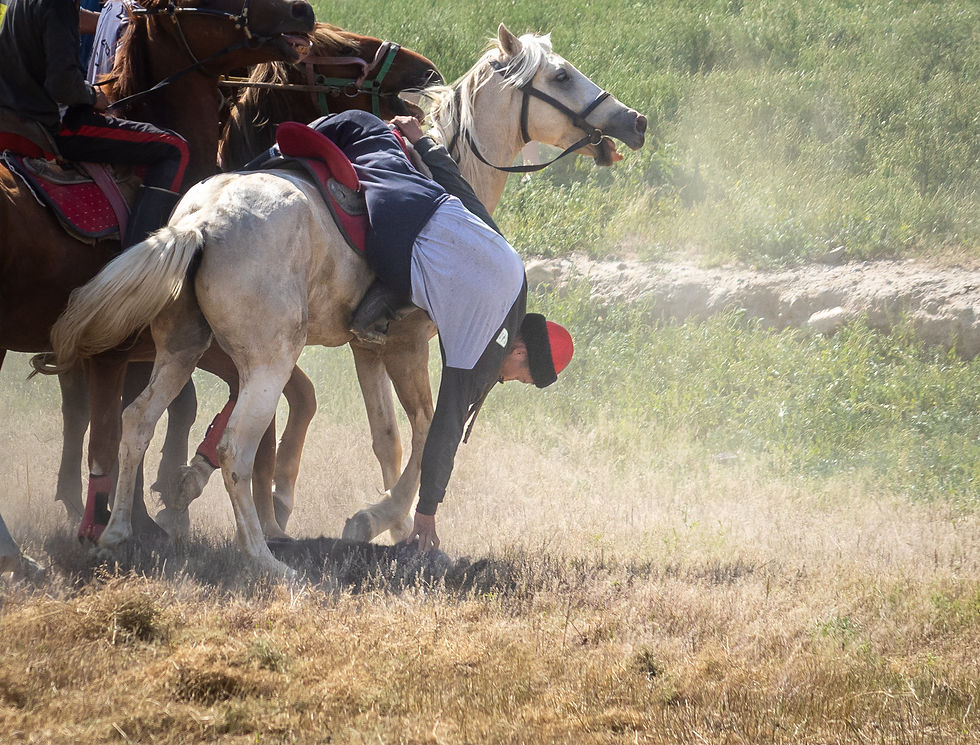
The riders grip the horses with their knees and lean impossibly far out of the saddle, their bodies hanging sideways as they reach toward the ground. Somehow, while galloping full speed, one rider manages to scoop eighty pounds of dead goat off the dirt with one arm.
I struggle to pick up a dropped set of car keys while standing still.
These guys make leaning so far off their horse that their shoulders drop below its belly, while galloping full speed toward a dead goat and fending off a dozen riders trying to throw them out of the saddle, look routine.
The lucky rider who manages to scoop all 80 pounds of goat carcass off the ground wheels his horse toward the goal and takes off at full speed, tucking the carcass under his leg to hold it tightly.

The sprint lasts about three seconds.
Then everyone else catches him.
Arms reach in from every direction.
Hands grab the goat.
The horses shove shoulder to shoulder.
The riders pull.
The game dissolves into what looks like a swirling knot of horses, dust, muscles, leather, and determination.
Eventually someone emerges from the scrum in possession of the macabre prize.
Off he goes.
For about three seconds.
Then everyone catches him again.
The whole process repeats itself.
Over.
And over.
And over.
Watching for the first time, I found myself wondering why the game flowed this way. Why didn't they simply pass the goat around the field the way soccer players move a ball or hockey players move a puck?
But have you ever tried throwing an eighty-pound bag of meat? I haven't either. There are probably good reasons for that. One of them is that, if you somehow managed it, the intended recipient would likely spend the remainder of the afternoon reconsidering your friendship front a hospital bed.
Suddenly the game made perfect sense.
The objective isn't to outrun the other team.
It's to survive the scrum long enough to escape it.
For about three seconds.
Strange(?)
I have noticed something over the years.
Travel changes what I think is strange. It doesn't have to. But it can.
The first time you encounter something unfamiliar, your instinct is to measure it against the world you already know.
We don't play sports with dead goats.
We don't sleep in yurts.
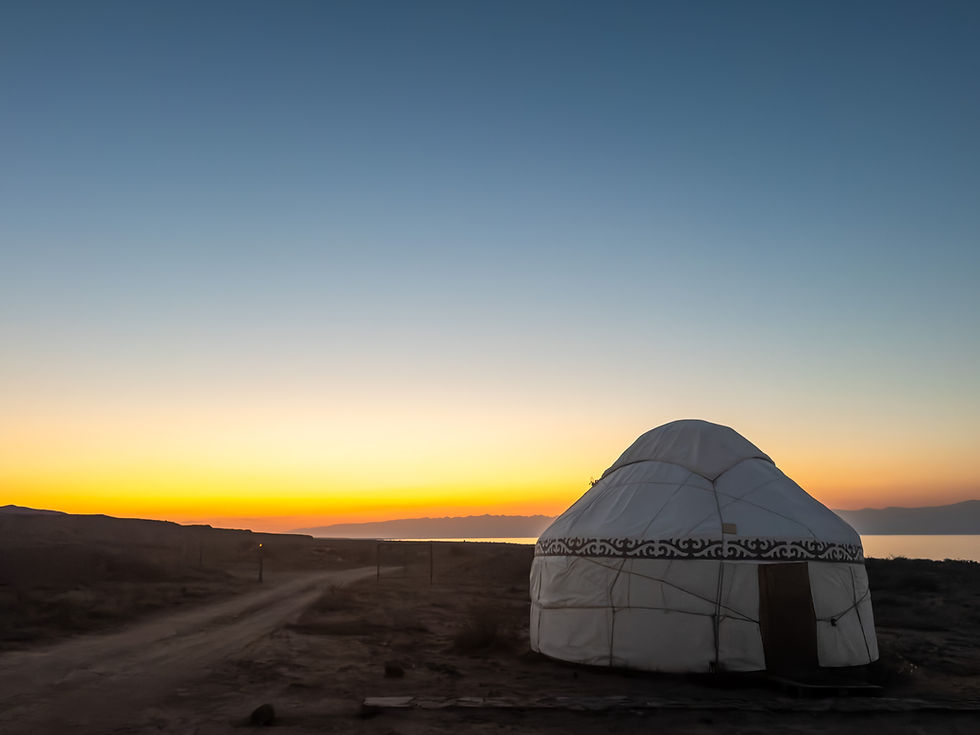
We don't hitchhike across mountain ranges.
We don't lounge by the stack of dried yak dung.
So your brain quietly concludes:
"Well... that's strange."
Then something happens.
You spend time with the people who do these things.
You listen.
You ask questions.
You watch.
And little by little, the unfamiliar stops feeling unfamiliar. The dead goat slowly disappears from center stage. Instead, you notice the astonishing horsemanship.
You notice the teamwork.
You notice the strategy.
You notice riders hanging impossibly far off the side of a galloping horse with the effortless confidence that only comes from a lifetime in the saddle.
Eventually, you stop watching the goat.
You start watching the game.
And somewhere along the way, something quietly changes.
Not the game.
You.
I've begun to think that's one of the greatest gifts travel can offer.
It doesn't teach you that everyone is the same.
They aren't.
People really do solve life's problems in wonderfully different ways.
What travel teaches is that those different answers usually make perfect sense once you understand the questions people were trying to answer.
On the Central Asian steppe, where horses shaped everyday life and horsemanship meant survival, kok boru is not bizarre.

It is history.
It is culture.
It is athleticism.
It is tradition.
It is home.
If you grew up under different circumstances, it may take a bit of mental adjustment to see that.
But that's okay.
That's why we travel.
Because travel doesn't make the world less strange. It makes strange disappear. At least, it does for me.


Comments